
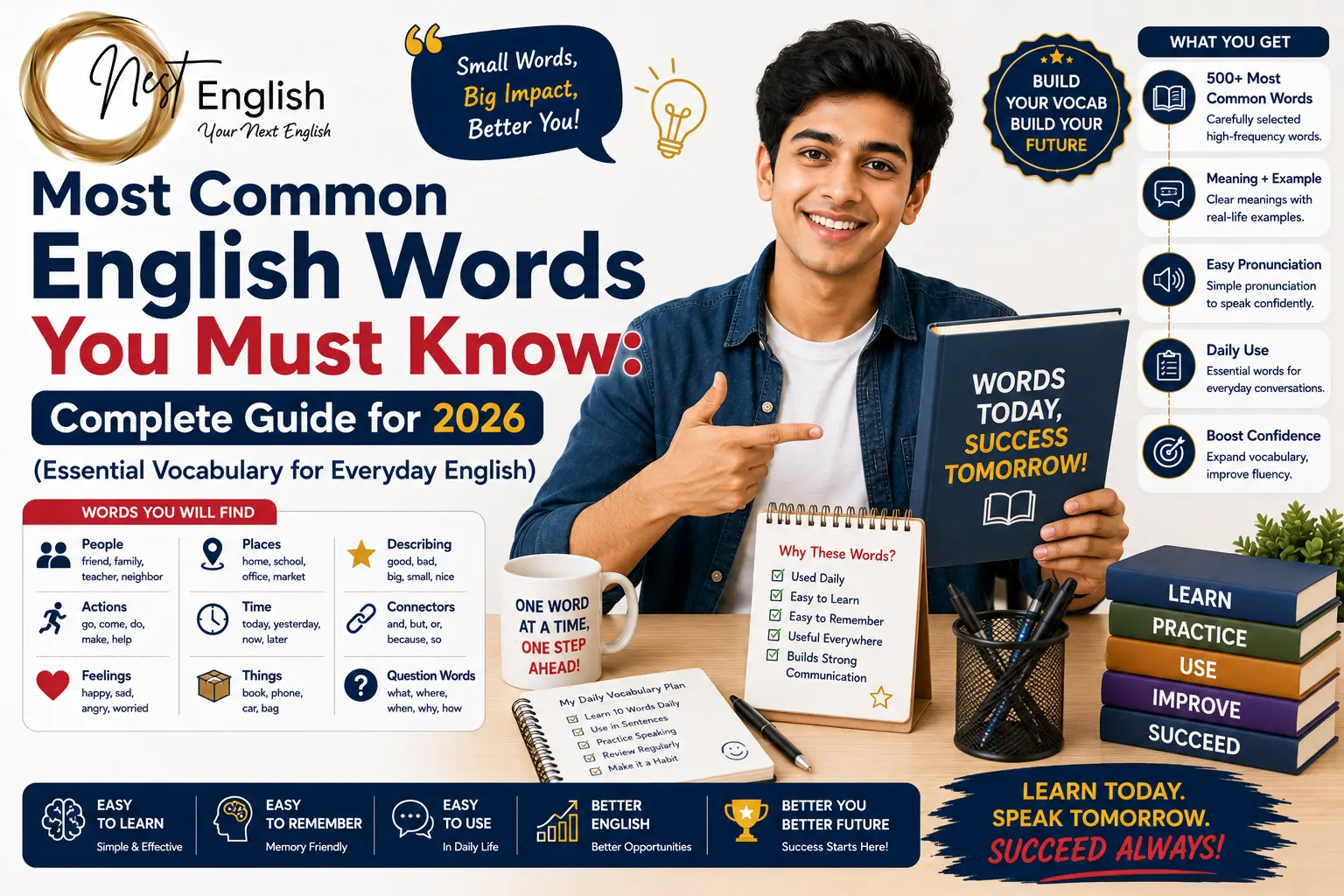

Most Common English Words You Must Know: Complete Guide for 2026 (Essential Vocabulary for Everyday English)
Introduction
Learning the most common English words is one of the fastest and most effective ways to improve communication skills. In 2026, English continues to dominate global communication across education, business, technology, travel, entertainment, and professional environments.
Whether you are preparing for IELTS, PTE, OET, Duolingo English Test, job interviews, study abroad programs, or everyday communication, building a strong foundation of common English words is essential.
Many English learners focus only on advanced vocabulary while overlooking the words that appear most frequently in daily conversations. Mastering these words significantly improves speaking, reading, writing, and listening skills.
Why Learning Common English Words Matters
A small group of frequently used words accounts for a large percentage of everyday English communication.
Benefits of Learning Common English Words
- Improved Speaking Fluency
- Better Listening Comprehension
- Stronger Reading Skills
- Enhanced Writing Ability
- Greater Communication Confidence
- Faster Language Learning Progress
What Are Common English Words?
Common English words are the words most frequently used in spoken and written communication. These words repeatedly appear in conversations, emails, books, websites, news articles, and social media platforms.
Where Common English Words Are Used
- Daily Conversations
- Social Media
- Business Communication
- Academic Writing
- Professional Meetings
- Travel Situations
- Emails & Messages
- Books & Articles
- Online Learning
- Job Interviews
Essential Categories of Common English Words
1. Everyday Communication Words
These words are used in almost every social interaction and are among the first words learners should master.
- Hello
- Hi
- Goodbye
- Please
- Thank You
- Sorry
- Welcome
- Excuse Me
- Friend
- Family
- Help
- Question
- Answer
- Problem
- Idea
- Hello, how are you today?
- Thank you for your help.
- Can you answer my question?
- My family lives in another city.
- I need your help with this project.
2. Common Action Words (Verbs)
Verbs describe actions and activities. They are essential for expressing ideas and communicating effectively.
- Go
- Come
- Speak
- Talk
- Learn
- Study
- Work
- Read
- Write
- Listen
- Watch
- Play
- Eat
- Drink
- Sleep
- Walk
- Run
- Think
- Understand
- Know
- I study English every day.
- She works in a hospital.
- We read books regularly.
- They speak English confidently.
- I understand the lesson now.
3. Common Descriptive Words (Adjectives)
Adjectives help describe people, places, objects, and situations, making communication more meaningful.
- Good
- Bad
- Happy
- Sad
- Beautiful
- Important
- Interesting
- Difficult
- Easy
- Successful
- Strong
- Weak
- Fast
- Slow
- Big
- Small
- New
- Old
- Smart
- Friendly
- This book is very interesting.
- She is a successful student.
- The exam was difficult.
- He is a friendly person.
- This is an important meeting.
4. Time and Daily Life Words
- Today
- Tomorrow
- Yesterday
- Morning
- Afternoon
- Evening
- Night
- Week
- Month
- Year
- Hour
- Minute
- Time
- Schedule
- Routine
- I have an exam tomorrow.
- We met yesterday evening.
- My morning routine includes reading.
- This project will take one week.
- Time management is important.
5. Education and Learning Words
Education-related vocabulary is essential for students preparing for school exams, university admissions, IELTS, PTE, OET, Duolingo English Test, and academic communication.
- School
- College
- University
- Student
- Teacher
- Professor
- Study
- Exam
- Test
- Assignment
- Homework
- Knowledge
- Learning
- Education
- Research
- Course
- Lesson
- Classroom
- Project
- Certificate
- The student completed the assignment successfully.
- Education creates new opportunities.
- I am preparing for an important exam.
- Knowledge grows through continuous learning.
- The teacher explained the lesson clearly.
6. Workplace and Career Words
Professional vocabulary helps learners communicate effectively in job interviews, workplaces, meetings, and business environments.
- Job
- Career
- Work
- Office
- Meeting
- Manager
- Team
- Project
- Client
- Communication
- Leadership
- Success
- Goal
- Strategy
- Performance
- Company
- Business
- Employee
- Employer
- Opportunity
- The team completed the project successfully.
- She received a promotion at work.
- Communication is important in business.
- The manager scheduled a meeting.
- Success requires consistency and effort.
7. Travel and Communication Words
Travel vocabulary is useful for international students, tourists, and professionals communicating across countries.
- Travel
- Airport
- Hotel
- Ticket
- Journey
- Passport
- Flight
- Reservation
- Destination
- Tourist
- Guide
- Map
- Information
- Transportation
- Luggage
- Vacation
- Tour
- Trip
- Arrival
- Departure
- I booked a flight for tomorrow.
- Keep your passport safe while traveling.
- The hotel is near the airport.
- Our destination is London.
- The journey was comfortable.
Top 100 Most Common English Words
- I
- You
- He
- She
- It
- We
- They
- Is
- Are
- Was
- Were
- Have
- Has
- Had
- Do
- Does
- Did
- Go
- Come
- See
- Know
- Think
- Make
- Take
- Get
- Give
- Work
- Study
- Learn
- Speak
- Read
- Write
- Listen
- Watch
- Play
- Eat
- Drink
- Sleep
- Walk
- Run
- Good
- Bad
- Happy
- Sad
- Big
- Small
- New
- Old
- Important
- Interesting
- People
- Person
- Family
- Friend
- School
- Student
- Teacher
- Job
- Career
- Business
- Home
- World
- Life
- Day
- Time
- Week
- Month
- Year
- Today
- Tomorrow
- Yesterday
- Morning
- Evening
- Night
- Help
- Problem
- Answer
- Question
- Idea
- Knowledge
- Success
- Opportunity
- Growth
- Experience
- Travel
- Information
- Communication
- Education
- Research
- Technology
- Health
- Money
- Future
- Goal
- Project
- Team
- Manager
- Company
- Learning
- Development
How to Learn Common English Words Effectively
1. Learn Words in Context
Sentence: Studying abroad creates new opportunities for students.
2. Practice Daily Usage
Vocabulary becomes permanent when used regularly in speaking and writing.
3. Read English Content Regularly
Reading newspapers, blogs, books, and articles naturally exposes learners to frequently used vocabulary.
4. Listen to Spoken English
Listening helps learners understand pronunciation, stress patterns, and natural word usage.
- Podcasts
- English News Channels
- YouTube Educational Videos
- Audiobooks
- English Interviews
Vocabulary Learning Pyramid
Step 2 → Understand the Meaning
Step 3 → Read Example Sentences
Step 4 → Speak the Word
Step 5 → Write the Word
Step 6 → Use the Word in Real Conversation
Memory Techniques for Faster Vocabulary Retention
Association Method
Connect new words to familiar ideas or experiences.
Visualization Method
Create a mental image for each new word.
Repetition Method
Review words regularly using spaced repetition.
Sentence Building Method
Create multiple sentences using the same word.
Daily Vocabulary Learning Plan
Building a strong vocabulary requires consistency rather than intensity. Learning a few useful words every day is far more effective than trying to memorize hundreds of words at once.
Morning Vocabulary Session (15–20 Minutes)
- Learn 5–10 new common English words
- Understand meanings and pronunciation
- Read example sentences
- Write words in a vocabulary notebook
Afternoon Vocabulary Session (15 Minutes)
- Use new words in speaking practice
- Create your own sentences
- Review previously learned vocabulary
- Practice pronunciation aloud
Evening Vocabulary Session (20 Minutes)
- Revise the day's vocabulary
- Complete flashcard exercises
- Read short English articles
- Test yourself without notes
30-Day Vocabulary Challenge
This challenge helps learners build a strong foundation of common English words within one month.
Week 1: Everyday Communication Vocabulary
- Greetings
- Polite expressions
- Family vocabulary
- Daily conversation words
- Common action verbs
Week 2: Education and Workplace Vocabulary
- Academic words
- Classroom vocabulary
- Office communication
- Business expressions
- Professional terminology
Week 3: Travel and Social Vocabulary
- Travel-related words
- Transportation vocabulary
- Hotel and tourism terms
- Communication phrases
- Social interaction words
Week 4: Advanced Everyday Vocabulary
- Opinion words
- Problem-solving vocabulary
- Technology terms
- Personal development words
- Success and career vocabulary
Advanced Vocabulary Building Techniques
1. Learn Synonyms and Antonyms
Understanding related words improves flexibility and communication skills.
Good → Excellent, Great, Wonderful
Bad → Poor, Terrible, Unpleasant
2. Use Vocabulary Clusters
Study related words together rather than individually.
School, Teacher, Student, Classroom, Exam, Assignment, Learning, Knowledge
3. Read Extensively
Reading exposes learners to vocabulary naturally and repeatedly.
- News websites
- Educational blogs
- Magazines
- Short stories
- Academic articles
4. Use Spaced Repetition
Review vocabulary at increasing intervals to improve long-term retention.
Common Vocabulary Learning Mistakes
1. Memorizing Without Usage
Words are quickly forgotten when they are not actively used.
2. Ignoring Pronunciation
Knowing a word's meaning is not enough if you cannot pronounce it correctly.
3. Learning Too Many Words at Once
Overloading the brain reduces retention and causes confusion.
4. Skipping Revision
Without revision, vocabulary fades from memory.
5. Not Using Vocabulary in Conversation
Real communication is essential for vocabulary mastery.
Vocabulary Strategies for English Proficiency Exams
IELTS Vocabulary Strategy
- Learn academic vocabulary
- Focus on synonyms
- Practice topic-based word lists
- Use vocabulary naturally in speaking and writing
PTE Vocabulary Strategy
- Improve reading vocabulary
- Practice collocations
- Focus on listening recognition
- Learn context-based meanings
OET Vocabulary Strategy
- Build healthcare-related vocabulary
- Learn medical communication terms
- Practice patient-care expressions
- Focus on professional language
Duolingo English Test Strategy
- Strengthen everyday vocabulary
- Improve word recognition speed
- Practice contextual vocabulary questions
- Expand general English knowledge
Benefits of Learning Common English Words
Academic Benefits
- Better exam performance
- Improved reading comprehension
- Higher writing scores
- Enhanced speaking fluency
Professional Benefits
- Improved workplace communication
- Better interview performance
- Stronger professional relationships
- Greater career opportunities
Personal Benefits
- Increased confidence
- Easier travel communication
- Better understanding of media content
- More effective daily conversations
Frequently Asked Questions
Why Are Common English Words Important?
They form the foundation of communication and appear repeatedly in daily conversations, reading materials, and professional environments.
How Many Words Should I Learn Daily?
Learning 5–10 useful words per day is effective, sustainable, and easier to remember.
Are Common Words Enough for Fluency?
They provide a strong foundation, but learners should continue expanding vocabulary over time.
What Is the Best Way to Remember New Words?
Use them regularly through speaking, writing, reading, and listening activities.
How Long Does It Take to Build Strong Vocabulary?
With daily practice, noticeable improvement can be seen within a few weeks, while long-term mastery develops over months and years.
Final Thoughts
The most common English words are the foundation of effective communication in 2026. By mastering these frequently used words, learners can improve fluency, understand conversations more easily, communicate confidently, and perform better in academic and professional environments.
Successful vocabulary learning is not about memorizing thousands of difficult words. It is about learning practical vocabulary, understanding how words are used, and applying them consistently in real-life situations.
Whether your goal is to improve spoken English, prepare for IELTS, PTE, OET, Duolingo English Test, study abroad, advance your career, or communicate confidently with people around the world, mastering common English words is one of the smartest investments you can make in your language-learning journey.
Stay consistent, practice daily, review regularly, and continue expanding your vocabulary. Every new word learned brings you one step closer to confident and successful English communication.
Start Learning Today
Learn 5–10 useful words every day, use them in real conversations, and watch your English vocabulary grow steadily throughout 2026 and beyond.