
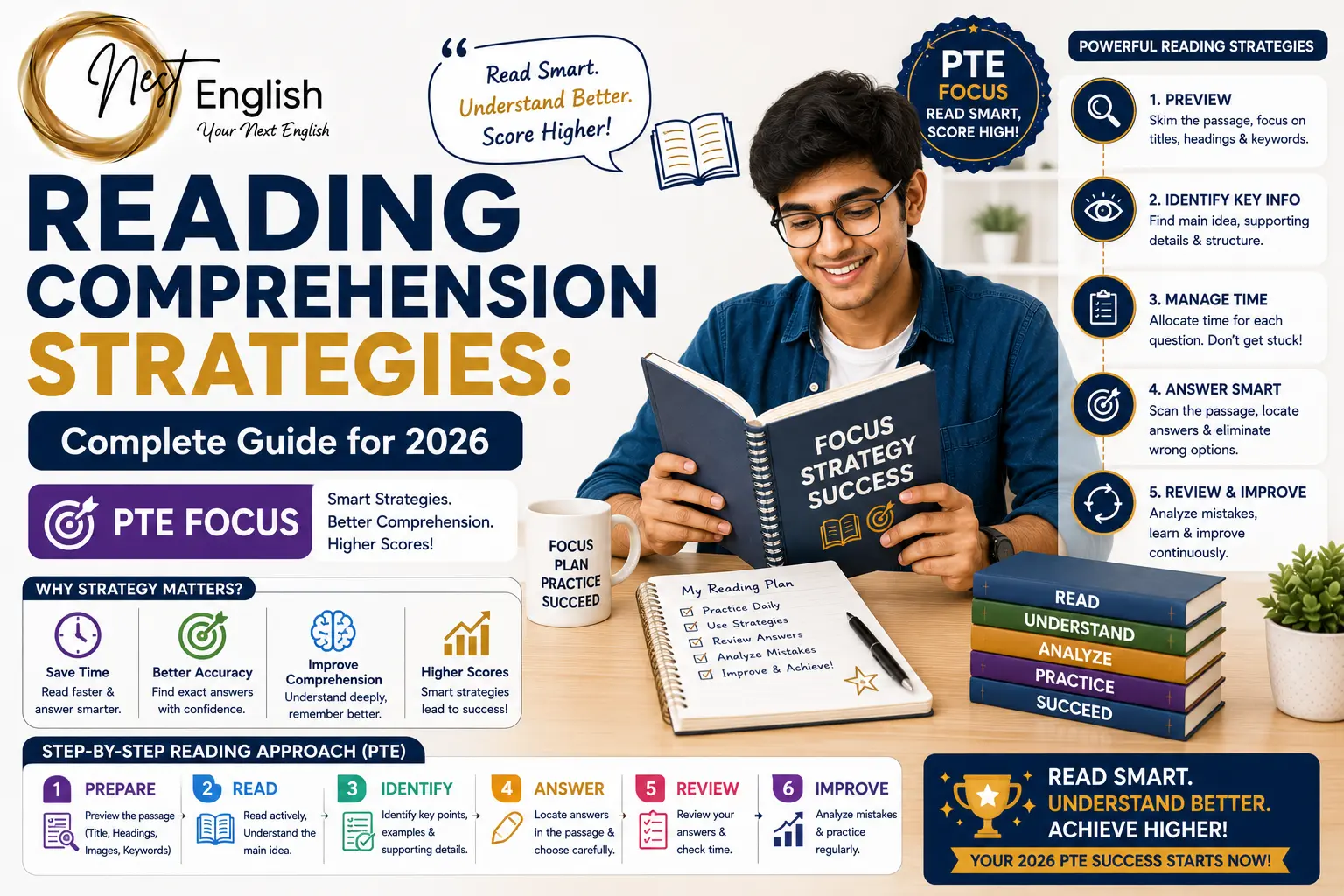

Reading Comprehension Strategies: Complete Guide for 2026 (PTE Focus)
Introduction
Reading comprehension is one of the most important skills assessed in the PTE Academic Reading section. In 2026, the examination continues to focus on a candidate’s ability to understand meaning, context, vocabulary, logical flow, and overall message within written passages.
Many students lose valuable marks not because they lack English proficiency, but because they do not use effective reading strategies. They often spend too much time reading every word, fail to identify key ideas, or struggle to locate important information quickly.
The good news is that reading comprehension is a skill that can be improved through consistent practice and the application of proven techniques. With the right strategies, students can read faster, understand passages more accurately, and answer questions with greater confidence.
This complete guide explores the most effective reading comprehension strategies for PTE candidates in 2026, helping learners improve both reading performance and overall exam scores.
Reading Comprehension Overview
| Feature | Details |
| Exam Focus | Understanding meaning, context, and logical structure of passages |
| Key Skills | Vocabulary, reasoning, scanning, skimming, interpretation |
| Target Exam | PTE Academic 2026 |
| Main Goal | Read faster and answer accurately |
What is Reading Comprehension?
Reading comprehension refers to the ability to understand, interpret, analyze, and evaluate written information. It involves more than simply recognizing words; it requires understanding the relationships between ideas and identifying the author’s intended message.
| Skills Tested | Purpose |
| Main Idea Identification | Understanding the overall topic and purpose of a passage |
| Detail Recognition | Locating important supporting information |
| Vocabulary Understanding | Interpreting words within context |
| Logical Reasoning | Understanding connections between ideas |
Strategy 1: Understand the Main Idea First
One of the most common mistakes students make is focusing on details before understanding the overall topic. Identifying the main idea first creates a framework that makes the rest of the passage easier to understand.
| Action | Benefit |
| Read the Title | Provides clues about the subject |
| Read Opening Paragraph | Introduces central ideas |
| Identify Author Purpose | Helps understand overall message |
Understanding the main idea creates a strong foundation for answering comprehension questions accurately.
Strategy 2: Use the Skimming Technique
Skimming is the process of reading quickly to obtain a general understanding of a passage without focusing on every detail.
| How to Skim Effectively |
|
• Read headings and subheadings • Focus on first and last sentences of paragraphs • Identify repeated words and concepts • Ignore minor details initially |
Skimming helps students save time and understand the overall structure of the passage before examining specific details.
Strategy 3: Use the Scanning Technique
Scanning involves searching a passage for specific information without reading everything carefully.
| When to Use Scanning | Examples |
| Finding Facts | Names, dates, statistics |
| Locating Keywords | Important terms from questions |
| Direct Questions | Specific information requests |
Scanning is one of the fastest ways to locate answers efficiently during the PTE Reading section.
Strategy 4: Focus on Keywords
Keywords act as signposts that guide students toward the correct answer. Learning to recognize keywords significantly improves speed and accuracy.
| Keyword Strategy | Purpose |
| Read Questions First | Know what information to search for |
| Identify Important Terms | Focus on meaningful words |
| Match Context | Locate related ideas in the passage |
Using keywords effectively allows candidates to locate answers faster and improve overall reading performance.
Strategy 5: Improve Vocabulary Understanding
Vocabulary plays a critical role in reading comprehension. Many PTE Reading questions test a candidate's ability to understand synonyms, contextual meanings, and academic language. A strong vocabulary allows students to interpret passages more accurately and answer questions with greater confidence.
| Vocabulary Strategy | Benefits |
| Learn Academic Word Lists | Improves understanding of common PTE vocabulary. |
| Study Synonyms & Antonyms | Helps recognize alternative expressions in questions. |
| Read Daily Articles | Expands vocabulary naturally through exposure. |
| Use Vocabulary Journals | Supports long-term retention and revision. |
Building vocabulary consistently is one of the most effective ways to improve reading comprehension and overall PTE performance.
Strategy 6: Read Questions Before the Passage
Reading the questions first helps candidates understand what information they need to locate while reading. This approach creates a purpose-driven reading process and improves efficiency.
| Advantages of Reading Questions First |
|
• Helps identify important keywords • Improves scanning efficiency • Reduces unnecessary reading • Saves valuable exam time • Improves answer accuracy |
Students who understand the questions before reading often find answers more quickly and avoid wasting time on irrelevant information.
Strategy 7: Eliminate Wrong Options
Many multiple-choice questions contain distractors designed to confuse candidates. Eliminating obviously incorrect answers increases the likelihood of selecting the correct option.
| Step | Action |
| Step 1 | Remove clearly incorrect options. |
| Step 2 | Compare remaining choices carefully. |
| Step 3 | Select the option that best matches the passage meaning. |
Using elimination techniques improves logical decision-making and reduces careless mistakes.
Strategy 8: Improve Logical Thinking
Reading comprehension is not only about understanding words. It also requires recognizing how ideas connect and how arguments develop throughout a passage.
| Logical Relationship | Example Focus |
| Cause and Effect | Understanding why something happened. |
| Comparison | Identifying similarities between ideas. |
| Contrast | Recognizing differences and opposing viewpoints. |
| Sequence | Understanding the order of events or processes. |
Strong logical reasoning skills help candidates interpret complex passages and answer inference-based questions correctly.
Common Mistakes in Reading Comprehension
Understanding common mistakes allows students to avoid ineffective reading habits and improve performance more quickly.
| Common Mistake | Impact | Solution |
| Reading Without Strategy | Wastes time and reduces accuracy. | Apply skimming and scanning methods. |
| Ignoring Keywords | Missing important information. | Identify keywords before reading. |
| Missing Main Idea | Poor overall understanding. | Focus on passage purpose first. |
| Guessing Randomly | Lower accuracy. | Use elimination techniques. |
| Spending Too Much Time | Time pressure later in exam. | Practice timed reading exercises. |
Avoiding these mistakes can significantly improve reading speed, comprehension accuracy, and overall PTE Reading performance.
Advanced Reading Strategies
| Strategy | Purpose |
| Active Reading | Engage with the text by asking questions while reading. |
| Sentence Connection Analysis | Understand how ideas connect logically between sentences and paragraphs. |
| Reading Speed Development | Improve efficiency and save time during the exam. |
| Daily Passage Practice | Build long-term reading comprehension skills through consistent exposure. |
Daily Reading Comprehension Practice Plan
A structured study routine can dramatically improve reading performance and help candidates develop stronger comprehension skills over time.
| Study Period | Recommended Activities |
| Weekdays (1–2 Hours) |
• Reading comprehension passages • Vocabulary-building exercises • Keyword identification practice • Question-solving activities |
| Weekends (2–3 Hours) |
• Full-length reading mock tests • Passage analysis sessions • Error correction reviews • Timed practice exercises |
Benefits of Strong Reading Comprehension Skills
Developing effective reading comprehension skills offers significant advantages not only for PTE performance but also for academic and professional success.
| Benefit Area | Advantages |
| Academic Benefits |
• Higher reading scores • Improved vocabulary recognition • Better understanding of academic texts |
| Exam Benefits |
• Faster question solving • Better time management • Increased accuracy |
| Professional Benefits |
• Stronger communication skills • Better document analysis abilities • Improved workplace performance |
| Personal Development |
• Enhanced critical thinking • Better logical reasoning • Greater confidence in English usage |
Frequently Asked Questions (FAQs)
| Question | Answer |
| Is Reading Comprehension Difficult? | No. With consistent practice and proper strategies, reading comprehension becomes much easier. |
| How Can I Improve Quickly? | Practice daily passages, improve vocabulary, and apply skimming and scanning techniques. |
| Should I Read the Entire Passage? | Not always. Strategic reading methods can save valuable time during the exam. |
| What Is the Most Important Strategy? | Understanding the main idea and identifying keywords are the most critical skills. |
Final Thoughts
Reading comprehension is a skill that develops through regular practice, strategic learning, and continuous improvement. In the PTE Academic exam, strong reading skills can significantly influence both Reading scores and overall performance.
Successful candidates focus on understanding main ideas, recognizing keywords, expanding vocabulary, and applying effective techniques such as skimming and scanning. Rather than reading every word, they learn to read efficiently and identify information quickly.
By following the strategies outlined in this guide and maintaining a consistent practice schedule, students can strengthen their comprehension abilities, improve exam performance, and achieve higher PTE scores in 2026 and beyond.