
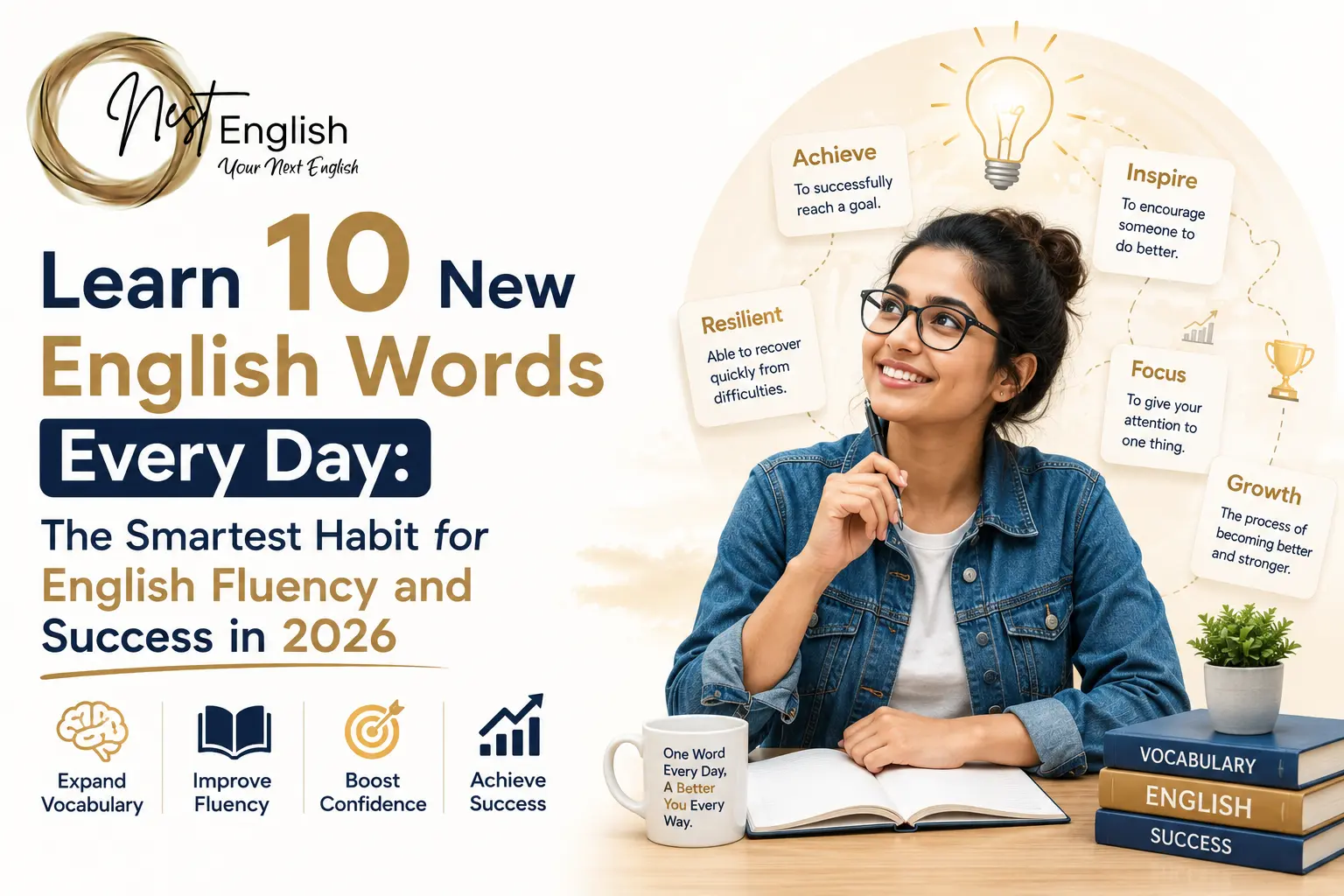

Learn 10 New English Words Every Day: The Smartest Habit for English Fluency and Success in 2026
Introduction
English has become the global language of education, business, technology, travel, and communication. Whether you are preparing for IELTS, PTE, TOEFL, competitive exams, job interviews, university admissions, or professional growth, strong English skills can create countless opportunities.
Among all language skills, vocabulary plays the most important role because words are the foundation of communication. One simple habit can dramatically transform your language skills: learning 10 new English words every day.
By learning ten words daily, students can acquire more than 3,600 new words in a year, significantly expanding their ability to communicate effectively.
Vocabulary Learning Overview
| Feature | Details |
| Daily Goal | Learn 10 new English words |
| Weekly Progress | 70 words |
| Monthly Progress | Approximately 300 words |
| Yearly Progress | More than 3,600 words |
| Best For | Students, professionals, IELTS/PTE learners, job seekers, and exam aspirants |
Why Vocabulary Is the Foundation of English
| Without Vocabulary | With Strong Vocabulary |
| Speaking becomes difficult | Communication improves |
| Writing lacks clarity | Confidence increases |
| Reading comprehension decreases | Academic performance strengthens |
| Listening becomes challenging | Professional opportunities expand |
The Power of Learning 10 Words Every Day
| Period | Words Learned |
| Daily | 10 words |
| Weekly | 70 words |
| Monthly | Approximately 300 words |
| Yearly | More than 3,600 words |
How Vocabulary Improves English Skills
| Skill | Benefits |
| Speaking | Faster responses, better sentence construction, improved confidence, greater fluency |
| Writing | Professional writing, better essays, stronger reports, improved email communication |
| Reading | Faster comprehension, improved retention, better understanding of complex texts |
| Listening | Follow conversations, understand lectures, comprehend podcasts, improve pronunciation awareness |
Vocabulary and Competitive Exams
| Exam | Why Vocabulary Matters |
| IELTS | Improves writing, speaking, reading, and listening performance |
| PTE | Supports fluency, pronunciation, and academic expression |
| TOEFL | Helps in academic reading, listening, and writing tasks |
| GRE / GMAT | Builds advanced vocabulary and analytical communication |
| Banking / Civil Services | Improves English section, comprehension, essays, and interviews |
Creating a Daily Vocabulary Routine
| Time | Activity |
| Morning Session | Learn five new words |
| Afternoon Session | Review previously learned words |
| Evening Session | Learn five additional words |
| Before Sleeping | Revise all ten words |
Where to Find New English Words
| Source | Advantage |
| Books | Introduce advanced vocabulary naturally |
| Newspapers | Provide current and formal language |
| Magazines | Offer topic-specific vocabulary |
| Educational Websites | Provide structured learning resources |
| Podcasts and Videos | Improve vocabulary through context |
Sample 10-Word Vocabulary List
| Word | Meaning | Example |
| Determined | Firmly committed to achieving a goal | She was determined to succeed in her studies. |
| Expand | To increase in size or scope | Reading helps expand vocabulary. |
| Inspire | To motivate someone positively | Successful people often inspire others. |
| Reliable | Dependable and trustworthy | He is a reliable team member. |
| Innovative | Introducing new ideas or methods | Technology companies value innovative thinking. |
| Achieve | To successfully accomplish something | Hard work helps students achieve their goals. |
| Opportunity | A favorable situation for success | Studying abroad creates new opportunities. |
| Confident | Believing in one's abilities | Practice makes speakers more confident. |
| Analyze | To examine carefully | Researchers analyze information before making decisions. |
| Adaptable | Able to adjust to new situations | International students must be adaptable. |
Vocabulary Notebook Format
| Include | Purpose |
| Word | Helps identify and remember the vocabulary item |
| Meaning | Builds clear understanding |
| Pronunciation | Improves speaking accuracy |
| Synonyms | Expands word relationships |
| Example Sentence | Shows real usage in context |
| Personal Usage | Helps apply the word confidently |
Learn Synonyms and Antonyms
| Word | Synonyms | Antonyms |
| Success | Achievement, Accomplishment, Victory | Failure, Defeat |
| Confident | Assured, Positive, Bold | Nervous, Doubtful |
| Expand | Increase, Grow, Extend | Reduce, Shrink |
Spaced Repetition Schedule
| Revision Stage | Day |
| First Review | Day 1 |
| Second Review | Day 3 |
| Third Review | Day 7 |
| Fourth Review | Day 14 |
| Final Review | Day 30 |
Common Vocabulary Learning Mistakes
| Mistake | Better Method |
| Memorizing Without Context | Learn every word through examples |
| Learning Too Many Words | Focus on 10 words daily |
| Ignoring Revision | Use daily and weekly review |
| Avoiding Practical Usage | Use new words in speaking and writing |
How Long Does It Take to See Results?
| Time Period | Expected Result |
| After One Month | Better word recognition |
| After Three Months | Improved reading ability |
| After Six Months | Stronger speaking confidence |
| After One Year | Significant vocabulary expansion |
90-Day Vocabulary Challenge
| Goal | Target |
| Daily Goal | Learn 10 new words |
| Weekly Goal | Review all learned vocabulary |
| Monthly Goal | Master approximately 300 words |
| Three-Month Goal | Learn nearly 900 words |
Final Thoughts
Learning 10 new English words every day is one of the most effective habits for improving language proficiency. It requires only a small daily commitment yet produces substantial long-term benefits across speaking, writing, reading, and listening.
A strong vocabulary improves academic performance, professional communication, examination results, and personal confidence. The secret to vocabulary growth is consistency rather than intensity.
Ten words a day may seem like a small step, but over time, those words can transform your confidence, fluency, and future opportunities. The journey to mastering English begins with a single word—and the best time to start is today.