
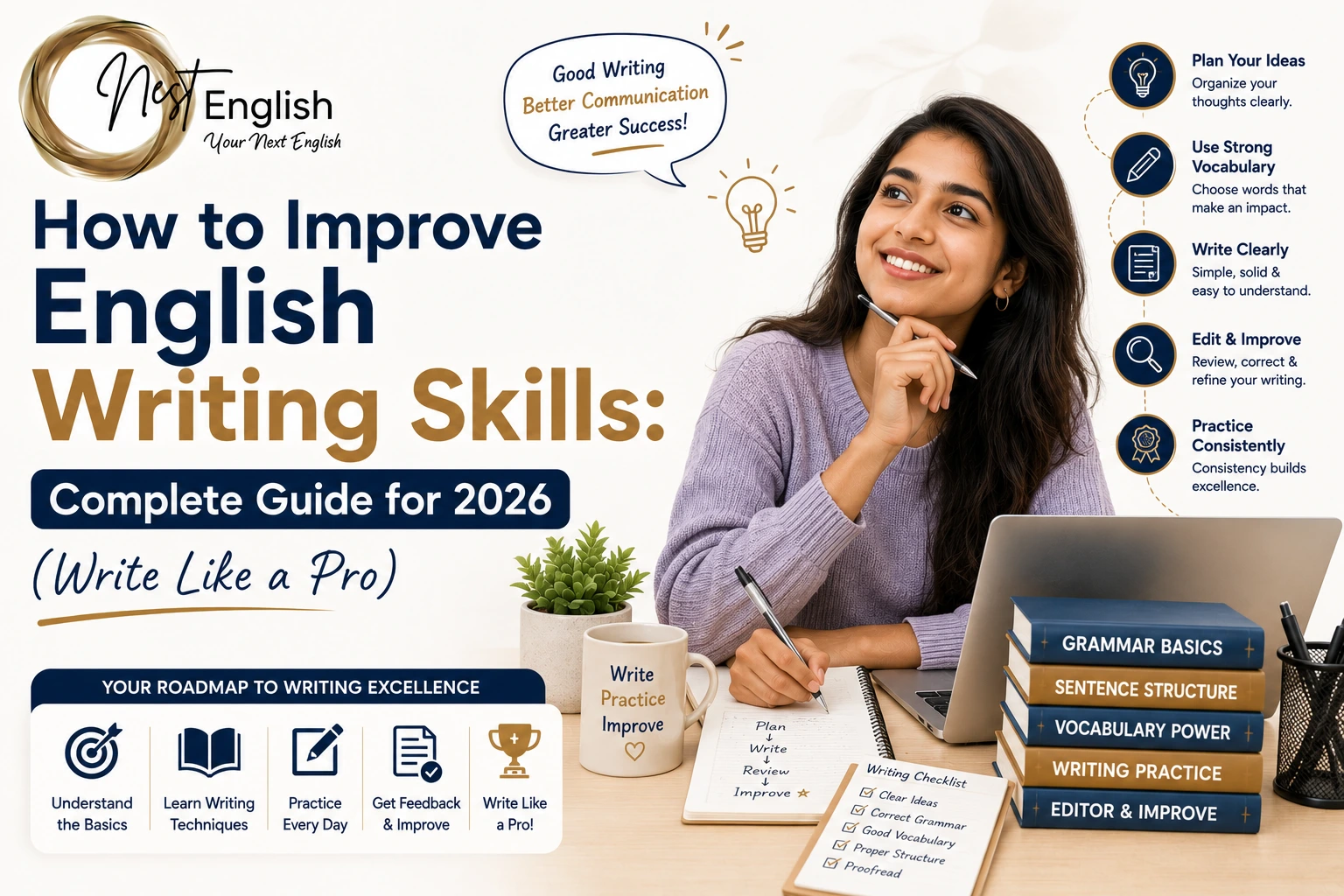

How to Improve English Writing Skills: Complete Guide for 2026 (Write Like a Pro)
Introduction
English writing skills are essential for exams, academics, business communication, and daily life. In 2026, strong writing ability helps students and professionals score higher in IELTS, PTE, school examinations, job applications, emails, and workplace communication.
Many learners understand grammar and vocabulary but still struggle to write effectively. This often happens because of limited practice, poor organization, and lack of a structured writing strategy.
This complete guide provides a practical roadmap to help learners improve English writing skills step by step and write with greater confidence and accuracy.
What Are English Writing Skills?
Definition
Key Elements of Strong Writing
| Element | Purpose |
|---|---|
| Grammar Accuracy | Ensures correctness |
| Vocabulary Usage | Makes writing stronger |
| Sentence Structure | Improves clarity |
| Coherence & Flow | Connects ideas smoothly |
| Organization | Creates logical structure |
Why Writing Skills Are Important
Key Reason
Benefits of Strong Writing Skills
- Higher examination scores
- Better academic performance
- Professional communication skills
- Clear expression of ideas
- Stronger career opportunities
Types of English Writing
1. Academic Writing
Academic writing is used in educational environments and examinations.
Used In:
- Essays
- Reports
- Assignments
- Examinations
Formal and structured paragraphs with logical arguments.
2. Professional Writing
Professional writing is used in workplaces and business environments.
Used In:
- Emails
- Business communication
- Office reports
- Project documentation
Formal tone, concise language, and clear messaging.
3. Creative Writing
Creative writing focuses on imagination, storytelling, and personal expression.
Used In:
- Stories
- Articles
- Blogs
- Creative content
Expressive and descriptive language designed to engage readers.
Step-by-Step Guide to Improve Writing Skills
1. Learn Basic Grammar Rules
Grammar forms the foundation of effective writing.
Focus Areas
- Tenses
- Sentence structure
- Subject-verb agreement
- Punctuation
- Articles and prepositions
2. Improve Vocabulary
A stronger vocabulary allows writers to express ideas more clearly and professionally.
Examples
| Basic Word | Advanced Alternative |
|---|---|
| Good | Excellent / Outstanding |
| Important | Crucial / Significant |
| Big | Enormous / Massive |
3. Practice Sentence Formation
Correct sentence construction improves clarity and readability.
Examples
- I go to school every day.
- She is reading a book.
- They completed the project successfully.
4. Learn Paragraph Structure
Well-organized paragraphs improve readability and help readers understand your ideas clearly.
Standard Paragraph Structure
| Section | Purpose |
|---|---|
| Introduction | Introduces the main idea |
| Body | Explains the topic with details and examples |
| Conclusion | Summarizes the key point |
Introduction: Technology has transformed education significantly.
Body: Students can access online courses, digital libraries, and interactive learning tools from anywhere in the world.
Conclusion: Therefore, technology has made education more accessible and effective.
5. Write Daily
Regular writing practice is one of the fastest ways to improve writing skills.
Daily Activities
- Write 5–10 sentences every day
- Maintain a personal journal
- Write short essays
- Create summaries of articles
- Practice email writing
Focus on consistency rather than quantity. Writing a little every day is more effective than writing a lot occasionally.
6. Read English Content Regularly
Reading exposes learners to vocabulary, sentence structures, and writing styles used by skilled writers.
Recommended Reading Materials
- News articles
- Blogs
- Academic essays
- Magazines
- Books
| Reading Type | Benefit |
|---|---|
| News Articles | Current vocabulary and formal language |
| Books | Improves sentence structure and style |
| Blogs | Conversational writing patterns |
| Academic Essays | Formal writing improvement |
7. Check and Correct Mistakes
Reviewing and editing your writing helps eliminate errors and improves accuracy over time.
Editing Checklist
- Check grammar mistakes
- Verify spelling
- Improve vocabulary choices
- Remove repetition
- Ensure sentence clarity
Never submit or publish writing without proofreading it carefully.
Common Writing Mistakes
1. Grammar Errors
| Incorrect | Correct |
|---|---|
| She go to school every day. | She goes to school every day. |
2. Wrong Word Order
| Incorrect | Correct |
|---|---|
| I very like English. | I like English very much. |
3. Incomplete Sentences
| Incorrect | Correct |
|---|---|
| Because I was tired. | I slept because I was tired. |
4. Repetition of Words
Using the same word repeatedly can make writing sound dull and unprofessional.
❌ The project was good. It had good planning and good results.
✔ The project was excellent. It had effective planning and impressive results.
Daily Practice Plan
Morning Practice
- Learn one grammar rule
- Study 10 new vocabulary words
- Review previous vocabulary
Afternoon Practice
- Write simple sentences
- Practice paragraph writing
- Rewrite sentences using better vocabulary
Evening Practice
- Read English articles
- Review and correct mistakes
- Maintain a writing journal
Tips for Fast Improvement
Improving writing skills becomes easier when learners follow proven techniques consistently. Small daily improvements often lead to significant long-term progress.
1. Keep Writing Simple
Simple and clear writing is usually more effective than complicated sentences.
Focus on clarity first. Advanced vocabulary and complex structures can be added gradually.
2. Focus on Accuracy Before Speed
Correct grammar, spelling, and sentence structure should be prioritized before attempting to write faster.
3. Practice Every Day
Daily writing strengthens language skills and develops confidence.
- Write short paragraphs
- Maintain a daily journal
- Practice essays and reports
- Summarize articles
4. Read and Copy Good Writing Styles
Reading quality content helps learners understand how professional writers organize ideas and use vocabulary effectively.
5. Learn from Mistakes
Every writing error provides an opportunity for improvement.
Do not fear mistakes. Correcting mistakes consistently is one of the fastest ways to become a better writer.
Benefits of Strong Writing Skills
| Benefit | Impact |
|---|---|
| Better Exam Scores | Improves performance in IELTS, PTE, OET, and academic exams |
| Professional Communication | Enhances workplace communication and email writing |
| Academic Success | Supports assignments, projects, and research work |
| Increased Confidence | Helps express ideas clearly and effectively |
| Career Growth | Creates better job and promotion opportunities |
How Writing Skills Support Competitive Exams
Strong writing skills directly contribute to success in language proficiency exams and academic assessments.
| Exam | Writing Benefit |
|---|---|
| IELTS | Improves Task 1 and Task 2 scores |
| PTE | Enhances essay and summary writing performance |
| OET | Supports professional healthcare writing tasks |
| Academic Exams | Improves essays, reports, and written responses |
Frequently Asked Questions
What Are English Writing Skills?
English writing skills are the ability to communicate ideas clearly, accurately, and effectively through written language.
How Can I Improve Writing Skills Fast?
Practice writing daily, improve grammar, expand vocabulary, read quality content, and regularly review mistakes.
Is Grammar Important for Writing?
Yes. Grammar forms the foundation of effective communication and helps readers understand your message correctly.
How Much Should I Practice Daily?
At least 20–30 minutes of focused writing practice every day is recommended for steady improvement.
Can Reading Improve Writing?
Absolutely. Reading exposes learners to vocabulary, sentence structures, writing styles, and organization techniques that naturally improve writing ability.
Long-Term Writing Development Strategy
Month 2: Build vocabulary and practice paragraph writing.
Month 3: Write essays, reports, and structured content regularly.
Month 4 and Beyond: Refine style, improve coherence, and develop advanced writing techniques.
Final Thoughts
Improving English writing skills in 2026 requires consistency, patience, and a structured approach. Writing is not merely a theoretical subject—it is a practical skill that develops through regular use and continuous improvement.
Learners who focus on grammar accuracy, vocabulary development, sentence structure, and daily writing practice can significantly improve their ability to communicate effectively. Reading quality English content and reviewing mistakes further accelerates progress.
Remember that every skilled writer started as a beginner. The secret to success is not perfection but persistence. Write regularly, learn from feedback, and continue improving one step at a time.
Write every day.
Read regularly.
Learn from mistakes.
Focus on clarity and accuracy.
Stay consistent.
Your journey toward professional English writing begins with a single sentence written today.
End of Guide – How to Improve English Writing Skills: Complete Guide for 2026 (Write Like a Pro)