
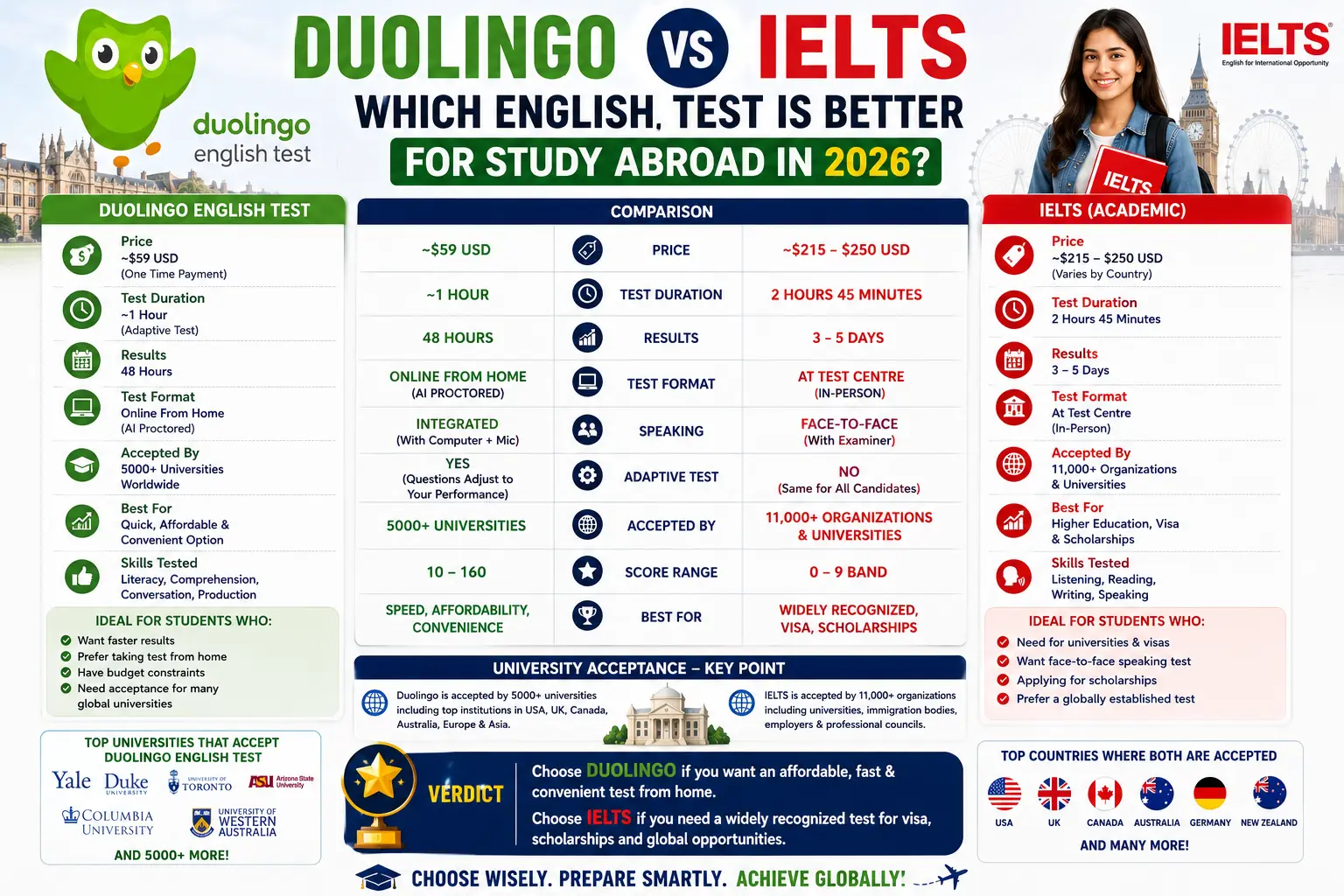

Duolingo vs IELTS: Which English Test Is Better for Study Abroad in 2026?
Introduction
English language proficiency is one of the most important requirements for students planning to study abroad. Universities and colleges across the world require international applicants to demonstrate their ability to communicate effectively in English through standardized language tests.
For many years, the International English Language Testing System (IELTS) has been the most widely accepted English proficiency examination. However, in recent years, the Duolingo English Test (DET) has emerged as a popular alternative due to its affordability, convenience, and online accessibility.
As more universities begin accepting Duolingo scores, students often face an important question: Which test is better for study abroad—Duolingo or IELTS?
The answer depends on several factors, including university requirements, budget, preferred test format, study destination, and future immigration plans.
This comprehensive guide compares Duolingo and IELTS across multiple parameters to help students make an informed decision in 2026.
English Proficiency Test Overview
| Feature | Details |
| Popular Tests | Duolingo English Test (DET) and IELTS |
| Purpose | University Admissions, Visa Applications, Academic Readiness, Language Assessment |
| Main Users | International Students, Professionals, Immigration Applicants |
| Best Year | 2026 |
| Key Decision Factors | Acceptance, Cost, Convenience, Visa Requirements, Long-Term Career Goals |
Duolingo vs IELTS: Quick Comparison
| Feature | Duolingo English Test | IELTS |
| Test Mode | Online from Home | Test Centre or Online |
| Duration | About 1 Hour | About 2 Hours 45 Minutes |
| Results | 48 Hours | 3–13 Days |
| Cost | Lower | Higher |
| Acceptance | Growing Rapidly | Widely Accepted Worldwide |
| Speaking Section | Computer-Based | Human Examiner |
| Convenience | Very High | Moderate |
| Immigration Acceptance | Limited | Extensive |
Understanding the Duolingo English Test (DET)
The Duolingo English Test (DET) is an online English proficiency examination that evaluates reading, writing, listening, and speaking skills through an adaptive testing system powered by artificial intelligence.
- Fully online examination
- Can be taken from home
- Adaptive question format
- Results available within 48 hours
- Lower registration fee
- Accepted by thousands of institutions worldwide
- No travel required
| Feature | Duolingo Details |
| Duration | Approximately 60 Minutes |
| Result Time | Usually Within 48 Hours |
| Test Environment | Online From Home |
| Best For | Affordable and Flexible Testing |
Understanding IELTS
IELTS is one of the world's most recognized English language proficiency tests and is accepted by universities, governments, immigration authorities, and professional organizations globally.
- Accepted worldwide
- Available in Academic and General Training formats
- Listening, Reading, Writing, and Speaking sections
- Human examiner speaking test
- Recognized for immigration purposes
- Strong global credibility
| Feature | IELTS Details |
| Duration | Approximately 2 Hours 45 Minutes |
| Result Time | 3–13 Days |
| Speaking Test | Face-to-Face Interview |
| Best For | Study, Work, Immigration, and Global Recognition |
Why English Proficiency Tests Matter
| Purpose | Why It Matters |
| Language Assessment | Measures English proficiency accurately. |
| University Admissions | Demonstrates readiness for academic studies. |
| Visa Applications | Supports study permit applications. |
| Communication Skills | Ensures students can study effectively in English. |
Test Format Comparison
The structure of an English proficiency test significantly influences the testing experience. Understanding the format helps students choose the examination that best matches their preferences and strengths.
| Component | Duolingo English Test | IELTS |
| Reading | Integrated Adaptive Questions | Separate Reading Section |
| Listening | Integrated Assessment | Separate Listening Section |
| Writing | Short Writing Tasks | Task 1 and Task 2 Writing |
| Speaking | Recorded Responses | Live Examiner Interview |
| Total Duration | Approximately 60 Minutes | Approximately 2 Hours 45 Minutes |
Cost Comparison
Budget plays a major role in study abroad planning. Test fees, travel expenses, and retake costs should all be considered before registering.
| Cost Factor | Duolingo | IELTS |
| Registration Fee | Lower | Higher |
| Travel Cost | Usually None | May Apply |
| Retake Expenses | More Affordable | Relatively Expensive |
| Overall Affordability | Excellent | Moderate |
Convenience and Accessibility
One of the biggest differences between Duolingo and IELTS is the level of convenience provided to test takers.
| Factor | Duolingo | IELTS |
| Testing Location | Home | Authorized Centre / Online |
| Scheduling | Highly Flexible | Fixed Dates |
| Travel Requirement | No | Usually Yes |
| Convenience Score | Very High | Moderate |
Acceptance by Universities
University acceptance remains one of the most important factors when choosing an English proficiency test.
| Acceptance Area | Duolingo | IELTS |
| USA | Widely Accepted | Widely Accepted |
| Canada | Many Universities Accept | Universally Accepted |
| United Kingdom | Growing Acceptance | Highly Accepted |
| Australia | Limited to Selected Institutions | Broad Acceptance |
| Overall Recognition | Growing | Excellent |
Acceptance for Student Visas
| Criteria | Duolingo | IELTS |
| University Admission | Accepted by Many Institutions | Universally Accepted |
| Study Visa Support | May Vary by Country | Widely Recognized |
| Work Visa Acceptance | Limited | Strong |
| PR Pathways | Generally Not Used | Commonly Accepted |
Difficulty Level Comparison
| Aspect | Duolingo | IELTS |
| Question Style | Adaptive | Structured |
| Preparation Resources | Growing | Extensive |
| Stress Level | Generally Lower | Moderate |
| Predictability | Less Predictable | Highly Predictable |
Speaking Section Comparison
| Feature | Duolingo | IELTS |
| Interaction | Recorded Responses | Live Interview |
| Evaluation | AI + Human Review | Certified Examiner |
| Best For | Shy Candidates | Confident Speakers |
Result Processing Time
| Test | Typical Result Time | Ideal For |
| Duolingo | Within 48 Hours | Urgent Applications |
| IELTS | 3–13 Days | Students Planning Ahead |
Acceptance for Student Visas
| Test | Visa Acceptance |
| IELTS | Widely accepted for student visas, work permits, and permanent residency applications. |
| Duolingo | Primarily used for university admissions; visa acceptance varies by country and immigration authority. |
Difficulty Level Comparison
| Aspect | Duolingo | IELTS |
| Question Style | Adaptive and dynamic | Structured and predictable |
| Preparation | Less traditional material available | Extensive preparation resources |
| Stress Level | Lower due to home testing | Formal testing environment |
Speaking Section Comparison
| Feature | Duolingo Speaking | IELTS Speaking |
| Interaction | Recorded responses | Face-to-face interview |
| Evaluation | AI and certified evaluators | Certified examiner |
| Best For | Students uncomfortable with interviews | Students confident in verbal communication |
Result Processing Time
| Test | Result Timeline |
| Duolingo | Typically available within 48 hours. |
| IELTS | Computer-based: a few days; Paper-based: usually longer. |
Which Test Is Better by Destination?
| Country | Recommended Test | Reason |
| Canada | IELTS | Preferred for visas, PGWP, and immigration pathways. |
| USA | Both | Many universities accept both tests. |
| United Kingdom | IELTS | Most widely accepted and traditionally preferred. |
| Australia | IELTS | Strong visa and migration acceptance. |
| New Zealand | IELTS | Preferred for admissions and immigration purposes. |
Advantages of Duolingo
- Affordable test fee
- Quick results
- Fully online examination
- Flexible scheduling
- Shorter duration
- No travel required
Advantages of IELTS
- Global recognition
- Immigration acceptance
- Extensive university acceptance
- Established credibility
- Abundant preparation resources
- Suitable for study, work, and migration