
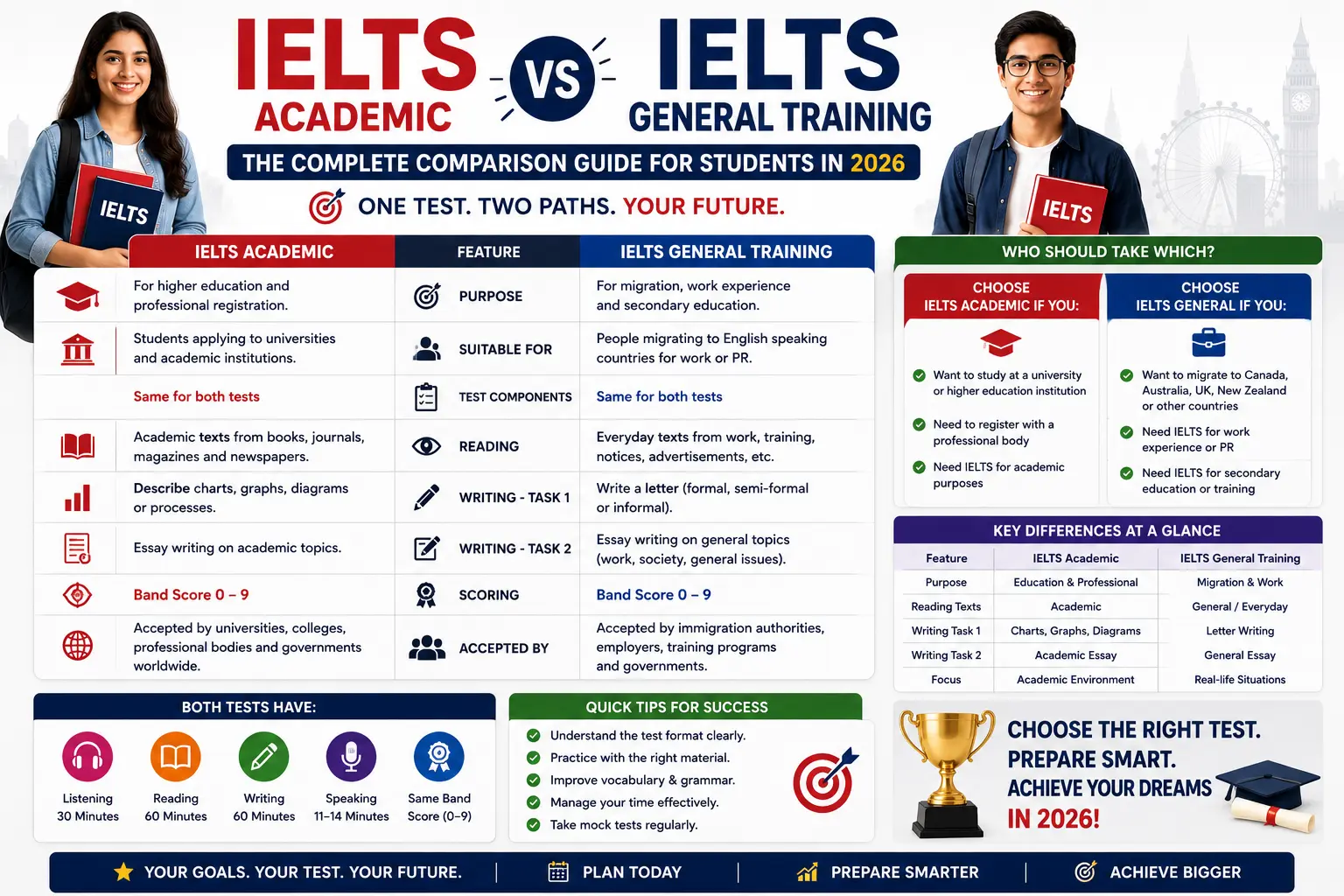

IELTS Academic vs IELTS General: The Complete Comparison Guide for Students in 2026
Introduction
The IELTS examination is one of the world's most recognized English language proficiency tests, accepted by universities, employers, professional organizations, and immigration authorities across numerous countries. Every year, millions of candidates take IELTS to pursue higher education, career opportunities, professional registration, and international migration.
One of the most common questions among test takers is whether they should choose IELTS Academic or IELTS General Training. While both examinations belong to the same IELTS system and assess the four core language skills—Listening, Reading, Writing, and Speaking—they are designed for different purposes and audiences.
Selecting the correct IELTS version is essential because universities, immigration authorities, and employers may require a specific test type. Understanding the differences between Academic and General IELTS can help candidates prepare more effectively and avoid costly mistakes.
IELTS Overview
| Feature | Details |
| Exam Name | International English Language Testing System (IELTS) |
| Versions Available | IELTS Academic and IELTS General Training |
| Skills Tested | Listening, Reading, Writing, Speaking |
| Band Score | 0 – 9 Scale |
| Primary Purpose | Study, Work, Professional Registration, Immigration |
What is IELTS Academic?
IELTS Academic is designed for individuals who plan to pursue higher education or professional registration in English-speaking environments. The test evaluates whether candidates possess the language skills required to succeed in academic settings such as universities, colleges, research institutions, and professional organizations.
- Designed for higher education applicants
- Accepted by universities worldwide
- Required for undergraduate and postgraduate admissions
- Suitable for professional registration programs
- Focuses on academic English language usage
| Purpose | University admissions and professional certification |
| Focus Area | Academic reading, academic writing, research-based language |
| Suitable For | Students, researchers, doctors, engineers, healthcare professionals |
What is IELTS General Training?
IELTS General Training is designed for candidates who need English for practical, everyday situations. It is commonly used for migration purposes, work opportunities, secondary education, and vocational training programs.
- Designed for immigration and work purposes
- Focuses on practical communication skills
- Suitable for workplace and social environments
- Commonly required for visa applications
- Emphasizes everyday English usage
| Purpose | Immigration, employment, vocational training |
| Focus Area | Practical communication, workplace English, daily life situations |
| Suitable For | Immigrants, job seekers, vocational trainees |
Academic vs General: Quick Comparison
| Feature | IELTS Academic | IELTS General |
| Main Purpose | Higher Education | Migration & Work |
| Reading Level | Academic Texts | Everyday English Texts |
| Writing Task 1 | Graphs, Charts, Diagrams | Letter Writing |
| Writing Task 2 | Essay Writing | Essay Writing |
| Listening | Same Format | Same Format |
| Speaking | Same Format | Same Format |
Difficulty Level Comparison
| IELTS Academic | IELTS General Training |
|
|
Overall, most candidates consider IELTS Academic slightly more challenging because of its academic reading passages and specialized writing tasks.
Scoring System
Both IELTS Academic and IELTS General use the same internationally recognized band score system.
| Band Score | English Proficiency Level |
| 9 | Expert User |
| 8 | Very Good User |
| 7 | Good User |
| 6 | Competent User |
| 5 | Modest User |
Important Note: The scoring system remains identical for both test versions. However, Reading and Writing sections contain different content and question types.
How to Choose Between IELTS Academic and IELTS General
| Choose IELTS Academic If... | Choose IELTS General If... |
|
|
Preparation Strategy Differences
| Preparation Area | Academic IELTS | General IELTS |
| Reading | Research articles, journals, academic texts | Advertisements, notices, workplace documents |
| Writing | Graphs, charts, essays | Letters and essays |
| Vocabulary | Academic and formal | Practical and everyday English |
| Focus | University-level communication | Daily and workplace communication |
A targeted preparation strategy ensures better performance and faster improvement.
Common Mistakes Students Make
| Mistake | Impact |
| Choosing the Wrong IELTS Version | Application rejection or delays |
| Ignoring Writing Differences | Lower writing scores |
| Lack of Reading Practice | Poor time management during the test |
| No Study Plan | Inefficient preparation |
Which One Is Easier?
| IELTS General Training | IELTS Academic |
|
|
Most candidates consider IELTS General Training slightly easier due to its practical focus and less complex reading materials. However, students planning to study abroad must usually take IELTS Academic regardless of difficulty.
Importance of Choosing the Correct IELTS Type
| Area | Why It Matters |
| University Admissions | Most universities specifically require IELTS Academic scores. |
| Immigration Applications | Many immigration programs require IELTS General Training. |
| Professional Registration | Healthcare and engineering professions often require Academic IELTS. |
| Preparation Efficiency | Selecting the correct version helps focus on relevant study materials. |
Choosing the correct IELTS version saves time, reduces preparation mistakes, and ensures your score meets the intended purpose.
Future Trends in IELTS Testing
English language assessment continues to evolve with technological advancements and changing educational requirements.
| Emerging Trend | Impact on Students |
| Computer-Based IELTS | Faster scheduling and quicker result delivery. |
| AI-Assisted Evaluation | More consistent and efficient scoring systems. |
| Personalized Learning Platforms | Customized preparation plans based on performance. |
| Adaptive Practice Systems | Targeted skill improvement through smart technology. |
| Enhanced Digital Testing | Greater flexibility and accessibility worldwide. |
These innovations are making IELTS preparation and testing more efficient for candidates worldwide.
Frequently Asked Questions (FAQs)
| Question | Answer |
| Can I switch between Academic and General IELTS? | Yes, but you must register and pay for a new test. |
| Is IELTS Academic harder than IELTS General? | Generally yes, especially in Reading and Writing sections. |
| Which IELTS is required for Canada PR? | IELTS General Training is commonly required for immigration pathways. |
| Which IELTS should I take for study abroad? | Most universities require IELTS Academic. |
| Do both tests use the same band score system? | Yes. Both are scored on the same 0–9 IELTS band scale. |
Final Comparison Summary
| If Your Goal Is... | Recommended IELTS Version |
| Study Abroad | IELTS Academic |
| Bachelor's Degree Admission | IELTS Academic |
| Master's Degree Admission | IELTS Academic |
| Professional Registration | IELTS Academic |
| Canada PR | IELTS General Training |
| Work Visa Applications | IELTS General Training |
| Migration Programs | IELTS General Training |
Final Thoughts
IELTS Academic and IELTS General Training are designed for different purposes, and understanding their differences is essential for success. While IELTS Academic focuses on higher education, research-based learning, and professional registration, IELTS General Training is designed for immigration, work opportunities, and practical communication needs.
Selecting the correct IELTS version helps candidates prepare effectively, use the right study resources, and meet university, immigration, or employment requirements without complications.
Both examinations require strong English language skills, consistent practice, and strategic preparation. Understanding the format, scoring system, and purpose of each test allows students to make informed decisions and maximize their chances of success.
Whether your goal is studying abroad, obtaining professional certification, securing a work visa, or pursuing immigration opportunities, choosing the appropriate IELTS version is the first step toward achieving your international aspirations in 2026 and beyond.