
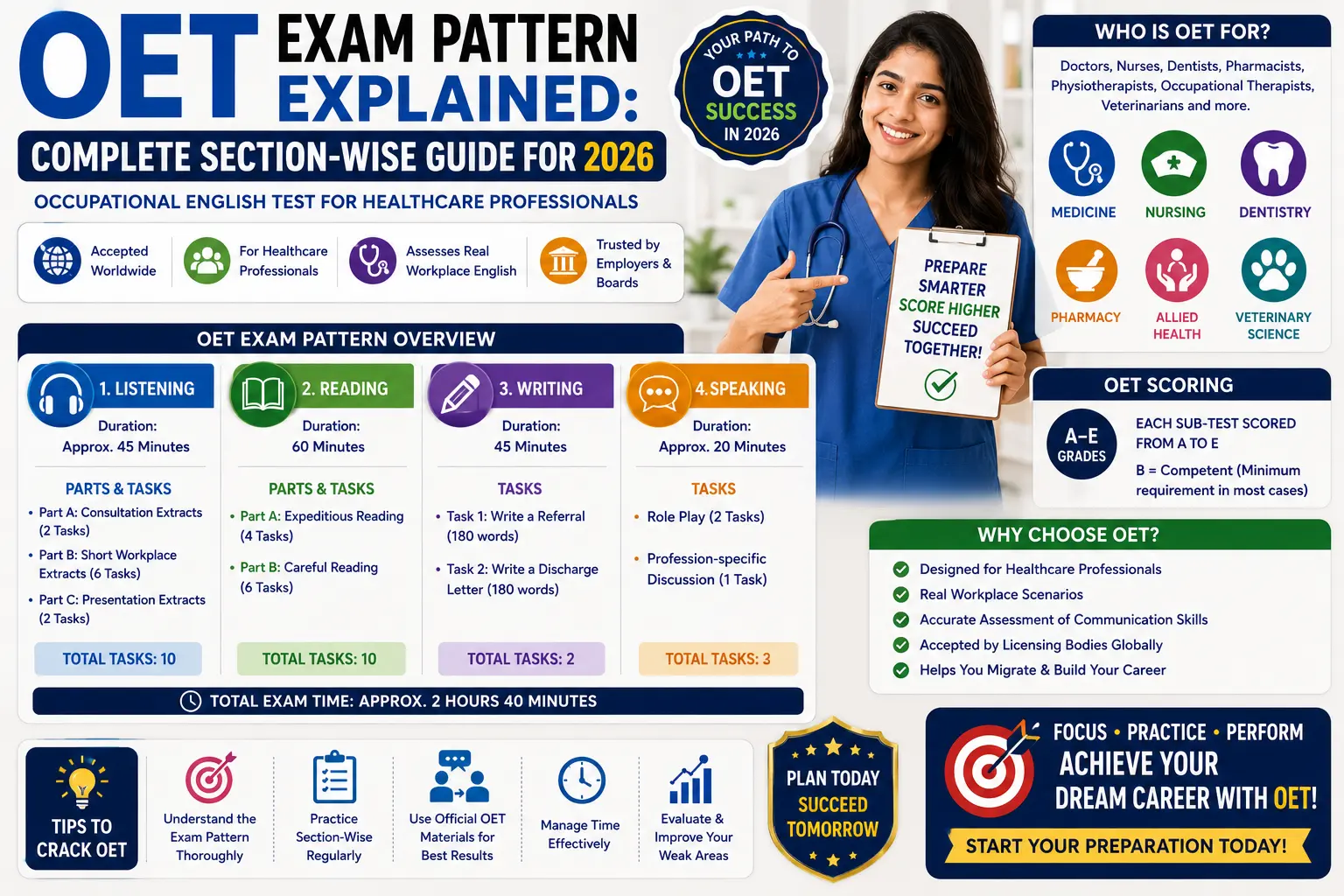

OET Exam Pattern Explained: Complete Section-Wise Guide for 2026
Introduction
The Occupational English Test (OET) is a healthcare-focused English language examination designed specifically for medical professionals. Unlike general English proficiency tests, OET assesses the language skills required in real healthcare environments, including hospitals, clinics, and patient-care settings.
In 2026, OET continues to be one of the most widely accepted English tests for healthcare registration and employment in countries such as the United Kingdom, Australia, New Zealand, Ireland, and several other healthcare destinations.
Understanding the exam pattern is the first step toward successful preparation. This guide explains every section of the OET exam in detail.
OET Exam Overview
| Feature | Details |
| Exam Name | Occupational English Test (OET) |
| Target Audience | Healthcare Professionals |
| Skills Tested | Listening, Reading, Writing, Speaking |
| Total Duration | Approximately 3 Hours |
| Scoring Scale | 0–500 Per Section |
| Grades | A, B, C+, C, D, E |
| Common Requirement | Grade B (350+) in most sections |
Section-Wise OET Exam Pattern
1. Listening Sub-Test
| Component | Details |
| Duration | 40–45 Minutes |
| Questions | 42 Questions |
| Purpose | Understanding healthcare-related conversations and presentations |
Listening Test Structure
| Part | Description |
| Part A | Two patient consultations with note-completion tasks. |
| Part B | Six short workplace conversations with multiple-choice questions. |
| Part C | Long medical presentations, interviews, and discussions. |
Skills Tested
- Understanding patient consultations
- Identifying key medical information
- Following clinical discussions
- Recognizing professional healthcare communication
- Listening for details and main ideas
2. Reading Sub-Test
The OET Reading section evaluates a healthcare professional's ability to understand and interpret medical texts quickly and accurately. Candidates must identify key information, comprehend workplace documents, and analyze longer healthcare-related passages.
| Component | Details |
| Duration | 60 Minutes |
| Parts | Part A, Part B, Part C |
| Focus | Medical text comprehension and information retrieval |
Reading Test Structure
| Part | Description |
| Part A | Fast information search and scanning tasks using four short healthcare texts. |
| Part B | Short workplace texts with multiple-choice questions. |
| Part C | Two longer healthcare-related articles requiring detailed comprehension. |
Skills Tested
- Speed reading
- Scanning and skimming techniques
- Understanding medical terminology
- Identifying key ideas
- Interpreting professional healthcare documents
3. Writing Sub-Test
The OET Writing section measures the candidate’s ability to communicate professionally through written healthcare correspondence. The task is based on real workplace situations and differs according to profession.
| Component | Details |
| Duration | 45 Minutes |
| Task Type | One Profession-Specific Letter |
| Focus | Professional healthcare communication |
Common Writing Tasks
| Letter Type | Purpose |
| Referral Letter | Referring a patient to another healthcare professional. |
| Discharge Letter | Providing patient information after discharge. |
| Transfer Letter | Transferring patient care responsibilities. |
Skills Tested
- Formal medical writing
- Professional tone
- Accurate patient information transfer
- Organization and clarity
- Language accuracy
4. Speaking Sub-Test
The Speaking section assesses the ability to communicate effectively with patients and caregivers in professional healthcare settings.
| Component | Details |
| Duration | Approximately 20 Minutes |
| Format | Two Role-Plays |
| Assessment Focus | Patient-centered communication |
Speaking Test Format
- Candidate acts as a healthcare professional.
- Examiner acts as a patient, caregiver, or relative.
- Each role-play simulates a real healthcare situation.
- Candidates receive preparation time before speaking.
- Focus is placed on empathy, clarity, and professionalism.
Skills Tested
- Patient interaction
- Professional communication
- Empathy and reassurance
- Information gathering
- Providing clear instructions
Complete OET Exam Pattern Summary Table
| Section | Duration | Format | Main Focus |
| Listening | 40–45 Minutes | 3 Parts, 42 Questions | Clinical Audio Understanding |
| Reading | 60 Minutes | 3 Parts | Medical Reading Comprehension |
| Writing | 45 Minutes | One Letter | Professional Medical Writing |
| Speaking | 20 Minutes | Two Role-Plays | Patient Communication Skills |
Key Features of the OET Exam Pattern
| Feature | Description |
| Healthcare-Based Content | All tasks are based on real medical and healthcare scenarios. |
| Profession-Specific Tasks | Writing and Speaking tasks are tailored to healthcare professions. |
| Practical Communication | Focuses on communication skills used in hospitals and clinics. |
| International Recognition | Accepted by healthcare regulators and employers worldwide. |
Common Mistakes Students Make
| Mistake | Impact | Solution |
| Ignoring Listening Part A | Misses valuable marks | Practice note-completion exercises daily |
| Not Practicing Role-Plays | Weak speaking performance | Conduct mock consultations regularly |
| Poor Reading Time Management | Incomplete answers | Use timed reading practice sessions |
| Weak Letter Structure | Lower writing scores | Learn referral and discharge letter formats |
| Not Understanding Exam Format | Reduced confidence | Study the complete test structure beforehand |
Preparation Tips for OET Success
| Preparation Strategy | Benefit |
| Understand Each Section | Builds familiarity and confidence |
| Practice Mock Tests | Simulates real exam conditions |
| Improve Medical Vocabulary | Enhances comprehension and communication |
| Practice Clinical Listening | Improves understanding of patient interactions |
| Use Writing Templates | Ensures professional and organized letters |
Frequently Asked Questions (FAQs)
| Question | Answer |
| Is OET Difficult? | Most healthcare professionals find it more relevant and practical than general English exams. |
| How Many Sections Are There? | Four sections: Listening, Reading, Writing, and Speaking. |
| What Is the Total Exam Duration? | Approximately three hours including all sections. |
| What Score Is Required? | Most healthcare boards require Grade B (350+) in each section. |
| Which Countries Accept OET? | UK, Australia, New Zealand, Ireland, and several other healthcare destinations. |
Benefits of Understanding the OET Exam Pattern
| Benefit Area | Advantages |
| Exam Readiness | Know exactly what to expect on test day. |
| Confidence Building | Reduces anxiety and improves performance. |
| Targeted Preparation | Allows efficient study planning. |
| Higher Scores | Improves overall performance across all sections. |
Final Thoughts
The Occupational English Test (OET) is specifically designed for healthcare professionals and focuses on real-world medical communication rather than general English proficiency. Understanding the exam pattern is one of the most important steps toward achieving a high score and meeting international healthcare registration requirements.
Each section—Listening, Reading, Writing, and Speaking—assesses different communication skills required in clinical settings. By familiarizing yourself with the format, practicing consistently, and focusing on profession-specific language, you can improve both confidence and performance.
As global demand for healthcare professionals continues to grow in 2026, a strong OET score can open doors to rewarding career opportunities in countries around the world. With structured preparation and a clear understanding of the exam pattern, success in OET is well within reach.