
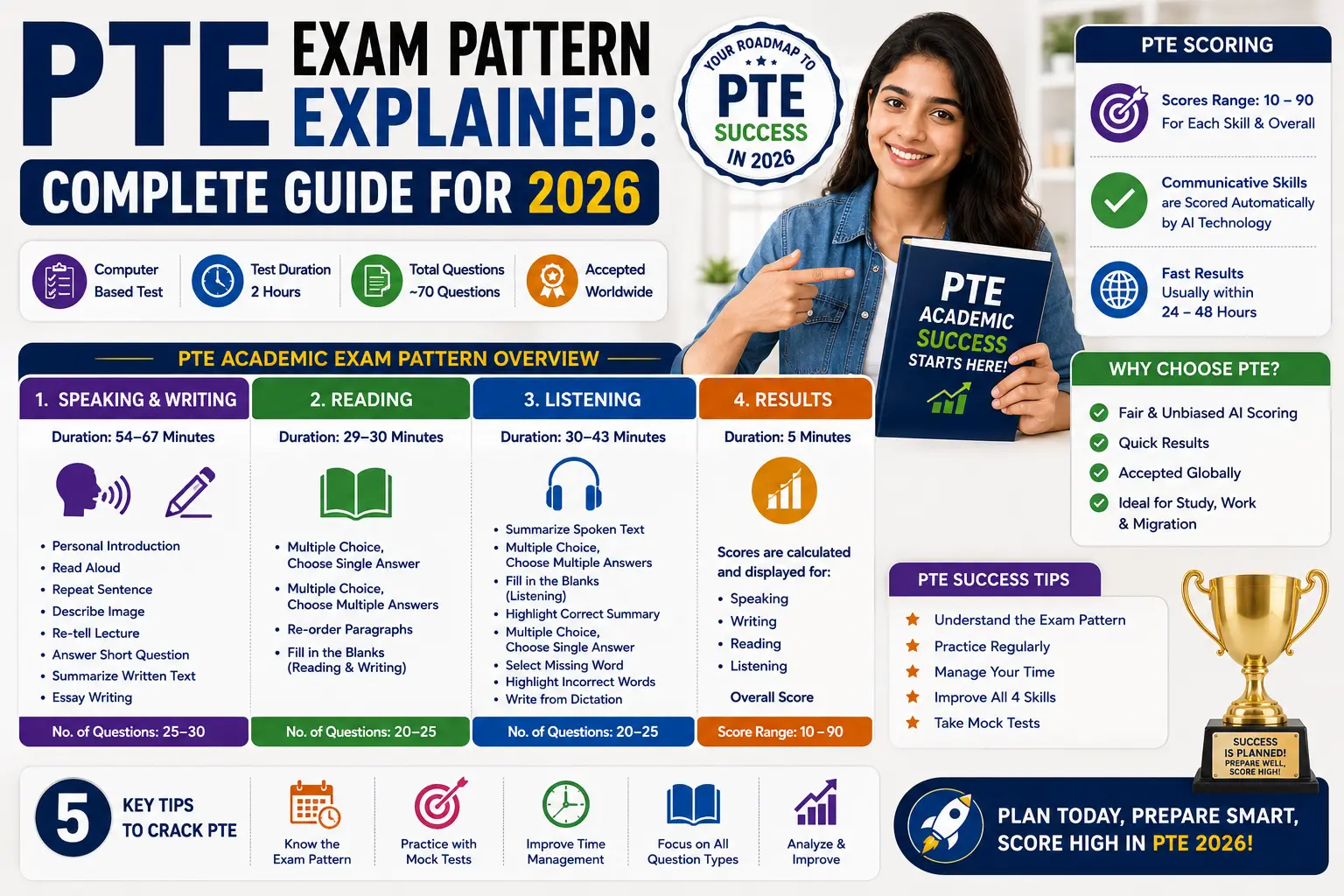

PTE Exam Pattern Explained: Complete Guide for 2026
Introduction
The Pearson Test of English (PTE Academic) is one of the most widely accepted English proficiency examinations for students, professionals, and migrants worldwide. Recognized by universities, governments, and professional organizations, PTE evaluates real-world English communication skills through a fully computer-based testing system.
In 2026, understanding the PTE exam pattern is one of the most important steps toward achieving a high score. Many candidates struggle not because of weak English skills but because they are unfamiliar with the structure, scoring system, and question types.
This comprehensive guide explains the complete PTE Academic exam pattern, including section-wise details, question types, scoring methods, and preparation insights to help candidates succeed.
PTE Exam Overview
| Feature | Details |
| Exam Name | Pearson Test of English (PTE Academic) |
| Exam Mode | Computer-Based Examination |
| Total Duration | Approximately 2 Hours |
| Accepted For | Study Abroad, Immigration, Professional Registration |
| Score Range | 10–90 Points |
| Result Time | Usually Within 24–48 Hours |
PTE Exam Structure
The PTE Academic examination consists of three main sections that evaluate a candidate’s ability to communicate effectively in English across academic and professional environments.
| Section | Approximate Duration | Main Skills Assessed |
| Speaking & Writing | 50–67 Minutes | Speaking, Writing |
| Reading | 29–30 Minutes | Reading Comprehension |
| Listening | 30–43 Minutes | Listening Skills |
1. Speaking & Writing Section
The Speaking and Writing section is the first and most influential part of the PTE exam. Performance in this section contributes significantly to the overall score.
| Speaking Tasks | Read Aloud, Repeat Sentence, Describe Image, Re-tell Lecture, Answer Short Question |
| Writing Tasks | Summarize Written Text, Essay Writing |
| Key Assessment Areas | Fluency, Pronunciation, Grammar, Vocabulary, Content |
This section requires candidates to demonstrate clear communication, accurate pronunciation, and strong writing organization.
2. Reading Section
The Reading section measures a candidate's ability to understand written English and identify information accurately.
| Question Types | Multiple Choice (Single Answer), Multiple Choice (Multiple Answers), Re-order Paragraphs, Fill in the Blanks |
| Duration | Approximately 29–30 Minutes |
| Skills Tested | Reading Speed, Vocabulary Knowledge, Context Understanding |
PTE Question Distribution Overview
| Section | Importance | Key Focus Area |
| Speaking & Writing | Highest Weightage | Fluency, Pronunciation, Grammar |
| Reading | Moderate Weightage | Vocabulary, Comprehension, Speed |
| Listening | High Weightage | Note-Taking, Concentration, Accuracy |
Key Features of the PTE Exam Pattern
Understanding the unique characteristics of the PTE Academic exam can help candidates develop a more effective preparation strategy.
| Computer-Based Test | The entire exam is conducted on a computer with AI-based evaluation and no face-to-face examiner interaction. |
| Integrated Skills Assessment | Many tasks assess multiple language skills simultaneously, making the exam highly practical. |
| AI Evaluation System | Advanced artificial intelligence evaluates responses objectively and consistently. |
| Real-World English | Questions are designed to reflect academic and workplace communication situations. |
| Fast Result Delivery | Most candidates receive scores within 24–48 hours after the exam. |
Common Mistakes Students Make While Understanding the PTE Pattern
Many candidates focus only on English improvement and overlook the importance of understanding the exam structure. This often leads to avoidable mistakes.
| Common Mistake | Impact on Performance |
| Ignoring Task Weightage | Missing high-scoring opportunities in tasks like Repeat Sentence and Write from Dictation. |
| Not Practicing Integrated Tasks | Lower performance in questions that assess multiple skills simultaneously. |
| Poor Time Management | Unable to complete sections effectively within the allocated time. |
| Ignoring Listening Practice | Reduced accuracy in dictation and note-taking tasks. |
| Lack of Familiarity with Question Types | Increased anxiety and lower confidence during the actual examination. |
How to Use the Exam Pattern for Better Preparation
Understanding the exam pattern helps candidates develop a focused and efficient study plan.
| Preparation Strategy | Why It Matters |
| Learn Every Question Type | Reduces surprises during the exam and improves confidence. |
| Focus on High-Scoring Tasks | Maximizes score improvement with targeted practice. |
| Practice Under Timed Conditions | Improves speed, stamina, and exam readiness. |
| Analyze Weak Areas | Helps allocate study time more effectively. |
PTE Scoring System
One of the most unique aspects of the PTE Academic exam is its fully computerized scoring system. Unlike traditional language exams that involve human examiners, PTE uses advanced Artificial Intelligence (AI) technology to evaluate candidate performance objectively and consistently.
| Scoring Feature | Details |
| Score Range | 10–90 Points |
| Evaluation Method | AI-Based Automated Assessment |
| Overall Score | Combined performance across all sections |
| Communicative Skills | Listening, Reading, Speaking, Writing |
| Enabling Skills | Grammar, Vocabulary, Pronunciation, Fluency, Spelling |
Benefits of Understanding the PTE Exam Pattern
Candidates who thoroughly understand the PTE structure often perform significantly better because they know what to expect on exam day and can prepare strategically.
| Benefit | How It Helps |
| Better Time Management | Allows candidates to allocate time effectively during preparation and examination. |
| Higher Accuracy | Improves familiarity with question types and reduces mistakes. |
| Reduced Exam Stress | Confidence increases when candidates know the exam format thoroughly. |
| Improved Preparation Strategy | Helps focus on important and high-scoring tasks. |
| Higher Overall Score | Strategic preparation often leads to better exam outcomes. |
Future Trends in PTE Testing
Technology continues to transform language assessment. PTE remains one of the most innovative English proficiency exams and is expected to become even more advanced in the coming years.
| Emerging Trend | Potential Impact |
| Advanced AI Evaluation | More accurate assessment of communication skills. |
| Personalized Learning Systems | Customized preparation recommendations based on performance. |
| Adaptive Practice Platforms | Smarter preparation tools tailored to individual needs. |
| Faster Results Processing | Even quicker score reporting for candidates. |
| Enhanced Analytics | Detailed performance feedback and skill tracking. |
Frequently Asked Questions (FAQs)
| Question | Answer |
| Is PTE difficult? | PTE is structured and predictable. With consistent practice, most candidates find it manageable. |
| How many sections are in PTE? | There are three main sections: Speaking & Writing, Reading, and Listening. |
| Is Speaking separate in PTE? | No. Speaking and Writing are combined into one section. |
| How important is Listening? | Listening contributes significantly to the overall score and requires focused preparation. |
| How quickly are results released? | Most candidates receive results within 24–48 hours after completing the exam. |
Final Thoughts
Understanding the PTE exam pattern is the foundation of successful preparation. Candidates who clearly understand the structure, question types, scoring system, and task requirements are far more likely to achieve their target scores.
The PTE Academic exam is designed to assess practical English communication skills through a modern, technology-driven testing environment. By mastering each section—Speaking & Writing, Reading, and Listening—candidates can significantly improve their performance and confidence.
Whether your goal is studying abroad, immigration, professional registration, or career advancement, a strong understanding of the PTE exam pattern can make your preparation more focused, efficient, and productive.
With consistent practice, smart preparation strategies, and familiarity with the exam format, achieving your desired PTE score in 2026 becomes a realistic and attainable goal.