
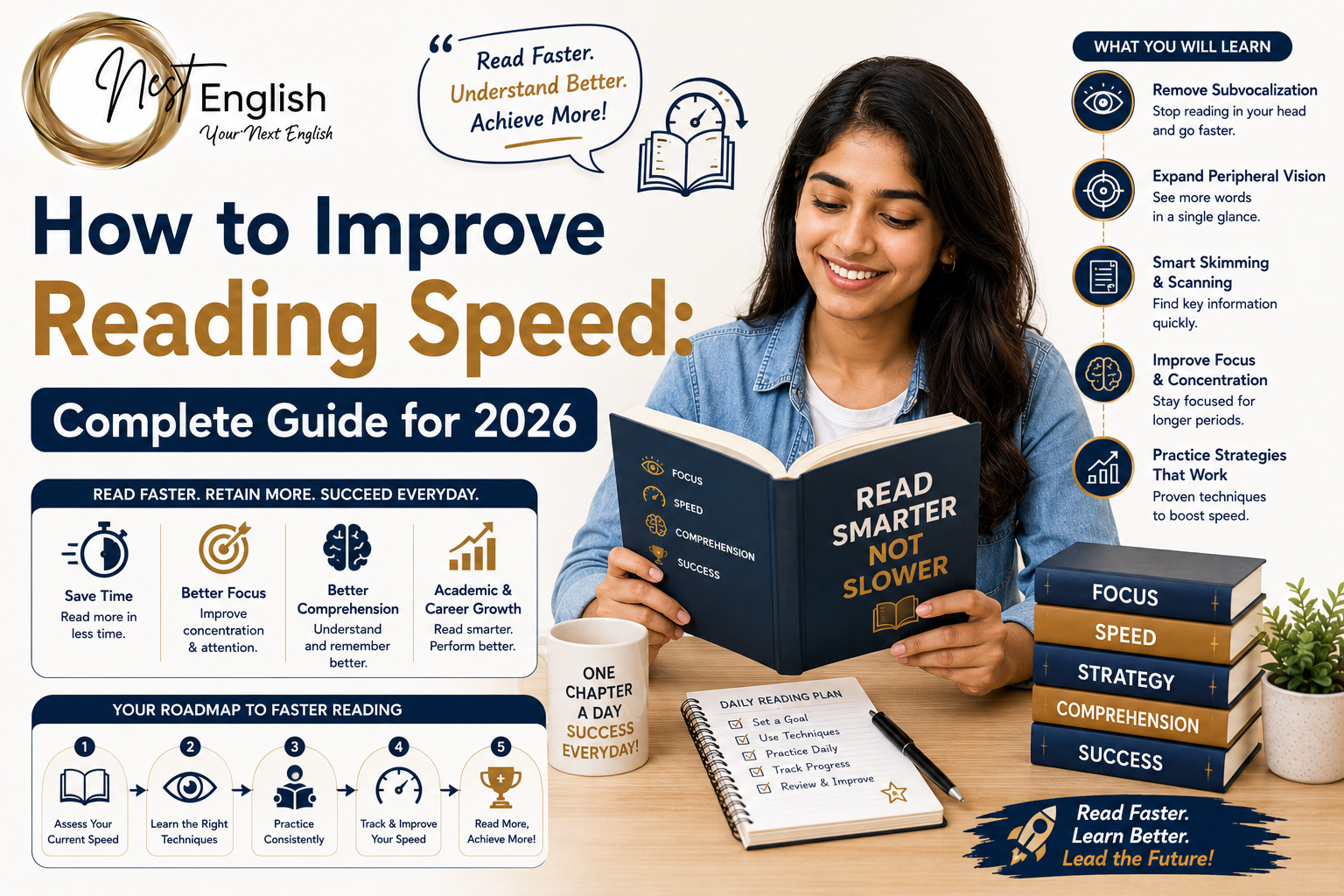

How to Improve Reading Speed: Complete Guide for 2026
Introduction
Reading speed is one of the most important skills for success in English proficiency examinations, academic studies, and professional communication. In exams such as PTE Academic, IELTS, TOEFL, and other competitive tests, candidates are often required to process large amounts of information within limited time.
Many students struggle not because they lack language knowledge, but because they read too slowly. Slow reading can lead to incomplete sections, poor time management, and increased exam stress. Improving reading speed allows learners to understand information more efficiently while maintaining strong comprehension.
In 2026, digital learning resources, AI-powered study tools, and interactive reading platforms have made it easier than ever to develop reading skills. However, improvement still depends on consistent practice and the application of proven reading techniques.
This complete guide explains why reading speed matters, common mistakes that slow readers down, and practical strategies that can help learners read faster while maintaining accuracy and comprehension.
Why Reading Speed Is Important
Reading speed directly affects performance in academic and professional environments. Faster readers can process information efficiently, answer questions more quickly, and complete reading-intensive tasks with greater confidence.
| Key Benefit | Impact |
|---|---|
| Time Management | Helps complete reading sections within the allotted time |
| Better Comprehension | Improves understanding of passages and key ideas |
| Reduced Stress | Creates a more comfortable exam experience |
| Higher Accuracy | Allows better focus on answering questions correctly |
| Score Improvement | Contributes to stronger overall exam performance |
Step-by-Step Methods to Improve Reading Speed
Developing reading speed requires a combination of technique, concentration, and regular practice. The following methods are widely recommended by language experts and reading specialists.
1. Stop Subvocalization (Reading in Your Mind Voice)
Subvocalization occurs when readers mentally pronounce every word while reading. Although common, this habit significantly reduces reading speed because the brain processes information at the pace of speech rather than at the pace of thought.
Why It Slows You Down
| Issue | Effect |
|---|---|
| Reading Every Word Internally | Limits reading speed to speaking speed |
| Over-Focus on Pronunciation | Reduces focus on overall meaning |
Recommended Solution
- Focus on understanding phrases rather than individual words.
- Train your eyes to move continuously across the text.
- Concentrate on meaning instead of pronunciation.
2. Practice Chunk Reading
Chunk reading involves reading groups of words together rather than processing one word at a time. This technique significantly increases reading efficiency and improves comprehension.
What It Means
Instead of reading individual words separately, readers train themselves to recognize complete phrases and meaningful units of information.
Example
| Slow Reading | Chunk Reading |
|---|---|
| The / economy / is / growing / rapidly | The economy is growing rapidly |
With practice, chunk reading becomes automatic and dramatically increases reading speed.
3. Improve Vocabulary
Vocabulary plays a major role in reading efficiency. Readers who instantly recognize words spend less time decoding meaning and can focus on understanding the overall message.
Why Vocabulary Matters
| Benefit | Result |
|---|---|
| Instant Word Recognition | Faster reading speed |
| Better Comprehension | Improved understanding of complex texts |
| Reduced Guesswork | More accurate interpretation of passages |
Recommended Strategy
- Learn 10–15 new words daily.
- Focus on academic and exam-related vocabulary.
- Study synonyms and related word families.
- Review vocabulary regularly through practice exercises.
4. Avoid Re-Reading Sentences
One of the most common habits that slows readers down is repeatedly going back to read the same sentence. While occasional review is necessary, excessive re-reading significantly reduces reading efficiency and wastes valuable time during examinations.
Common Problem
Many students lack confidence in their understanding and continuously revisit previously read lines. This habit interrupts reading flow and reduces overall speed.
Recommended Solution
- Read actively and stay focused.
- Trust your first understanding whenever possible.
- Move forward instead of stopping repeatedly.
- Review only when absolutely necessary.
| Habit | Effect on Speed |
|---|---|
| Frequent Re-Reading | Significantly slows reading progress |
| Single Focused Reading | Improves speed and confidence |
5. Use the Skimming Technique
Skimming is a reading technique used to quickly understand the main idea of a passage without reading every single word. It is especially useful in PTE, IELTS, and academic reading tasks.
What Is Skimming?
Skimming focuses on identifying the overall meaning, structure, and key points of a text.
How to Skim Effectively
- Read headings and subheadings.
- Focus on opening and closing sentences.
- Identify keywords and repeated ideas.
- Ignore minor details initially.
| Skimming Benefit | Result |
|---|---|
| Quick Understanding | Saves valuable exam time |
| Improved Navigation | Locates important information faster |
| Better Comprehension | Creates a clear understanding of passage structure |
6. Use the Scanning Technique
Scanning is a targeted reading method used to locate specific information quickly without reading the entire passage.
What Is Scanning?
Instead of reading every sentence, the reader searches for particular words, numbers, names, dates, or phrases.
Examples of Scanning
- Finding a specific date in a passage.
- Locating a person's name.
- Searching for statistics or numbers.
- Identifying keywords in a question.
| Information Type | Scanning Use |
|---|---|
| Names | Quick identification |
| Numbers | Fast retrieval of data |
| Keywords | Locate relevant information efficiently |
| Dates | Answer factual questions quickly |
7. Practice Timed Reading Daily
Reading speed improves through regular training. Timed reading helps learners gradually increase speed while maintaining comprehension.
Recommended Training Method
- Read articles using a timer.
- Measure reading speed regularly.
- Gradually reduce reading time.
- Increase passage difficulty over time.
| Practice Activity | Purpose |
|---|---|
| Timed Reading Sessions | Build reading speed |
| Progress Tracking | Monitor improvement |
| Difficulty Increase | Prepare for academic texts |
8. Improve Focus and Concentration
Concentration is essential for reading efficiently. Even strong readers struggle when distractions interrupt their focus.
Common Problem
External distractions and multitasking reduce comprehension and force readers to revisit previously read material.
Recommended Solutions
- Read in a quiet environment.
- Turn off unnecessary notifications.
- Avoid multitasking while studying.
- Establish a consistent daily reading habit.
| Focus Technique | Benefit |
|---|---|
| Quiet Study Environment | Improves concentration |
| No Multitasking | Enhances comprehension |
| Daily Reading Routine | Builds long-term improvement |
Common Mistakes That Reduce Reading Speed
Many learners unknowingly develop habits that slow down their reading performance. Identifying and eliminating these habits can significantly improve speed and comprehension.
| Common Mistake | Impact on Reading |
|---|---|
| Reading Word by Word | Slows overall reading speed |
| Limited Vocabulary | Causes frequent pauses and confusion |
| Poor Concentration | Leads to missed information |
| Overthinking Meaning | Interrupts reading flow |
| Excessive Re-Reading | Reduces efficiency and wastes time |
Advanced Techniques to Improve Reading Speed
Once the basic reading strategies have been mastered, learners can adopt advanced techniques to further increase speed and comprehension.
1. Use the Pointer Method
The pointer method involves using a finger, pen, or cursor to guide eye movement while reading. This technique helps maintain focus and reduces unnecessary eye movement.
| Benefit | Result |
|---|---|
| Guided Eye Movement | Faster reading flow |
| Improved Focus | Reduced distractions |
2. Read Simple Articles First
Beginning with easier reading materials helps build confidence and reading momentum before progressing to more complex academic texts.
| Reading Level | Purpose |
|---|---|
| Simple Articles | Build confidence and speed |
| Intermediate Texts | Develop comprehension skills |
| Academic Passages | Prepare for examinations |
3. Increase Difficulty Gradually
Gradual progression allows learners to adapt to more challenging vocabulary, sentence structures, and academic content without becoming overwhelmed.
- Start with short articles and blogs.
- Move to newspaper editorials and magazines.
- Progress to academic journals and research-based content.
- Practice with examination passages regularly.
4. Build a Daily Reading Habit
Consistency is the most important factor in reading improvement. Daily reading strengthens comprehension, vocabulary, and speed over time.
| Habit | Long-Term Benefit |
|---|---|
| Daily Reading | Steady improvement in speed |
| Vocabulary Review | Better word recognition |
| Regular Practice Tests | Improved exam readiness |
Daily Practice Plan
Weekday Schedule (1–2 Hours)
| Activity | Duration |
|---|---|
| Timed Reading Practice | 30 Minutes |
| Vocabulary Building | 30 Minutes |
| PTE Reading Exercises | 30–60 Minutes |
Weekend Schedule (2–3 Hours)
| Activity | Purpose |
|---|---|
| Full Reading Mock Tests | Exam simulation |
| Speed Analysis | Track reading progress |
| Error Review | Improve comprehension accuracy |
Benefits of Improving Reading Speed
| Benefit | Outcome |
|---|---|
| Faster Exam Completion | Better time management |
| Better Passage Understanding | Improved comprehension |
| Higher Accuracy | More correct answers |
| Reduced Stress | Greater confidence during exams |
| Improved Overall Scores | Enhanced academic performance |
Frequently Asked Questions (FAQs)
Can Reading Speed Be Improved?
Yes. Most learners can significantly improve reading speed through consistent practice and proven reading techniques.
How Long Does Improvement Take?
Many learners notice measurable improvements within two to four weeks of regular practice.
Does Vocabulary Improve Reading Speed?
Yes. Strong vocabulary allows readers to recognize words instantly, reducing hesitation and improving comprehension.
Should I Read Aloud to Increase Speed?
No. Reading aloud generally slows reading speed because it limits processing to speaking speed rather than thinking speed.
Final Thoughts
Reading speed is a critical skill for success in PTE Academic and other English proficiency examinations. Candidates who can process information quickly while maintaining comprehension gain a significant advantage in both exam performance and academic studies.
Techniques such as chunk reading, skimming, scanning, vocabulary development, and timed practice can dramatically improve reading efficiency when applied consistently.
Remember that effective reading is not about rushing through text. It is about understanding information accurately and efficiently. With regular practice and the right strategies, learners can significantly improve both speed and comprehension.
Stay consistent, practice daily, and gradually challenge yourself with more advanced reading materials. Over time, faster reading will become a natural skill that supports your academic, professional, and examination goals.