
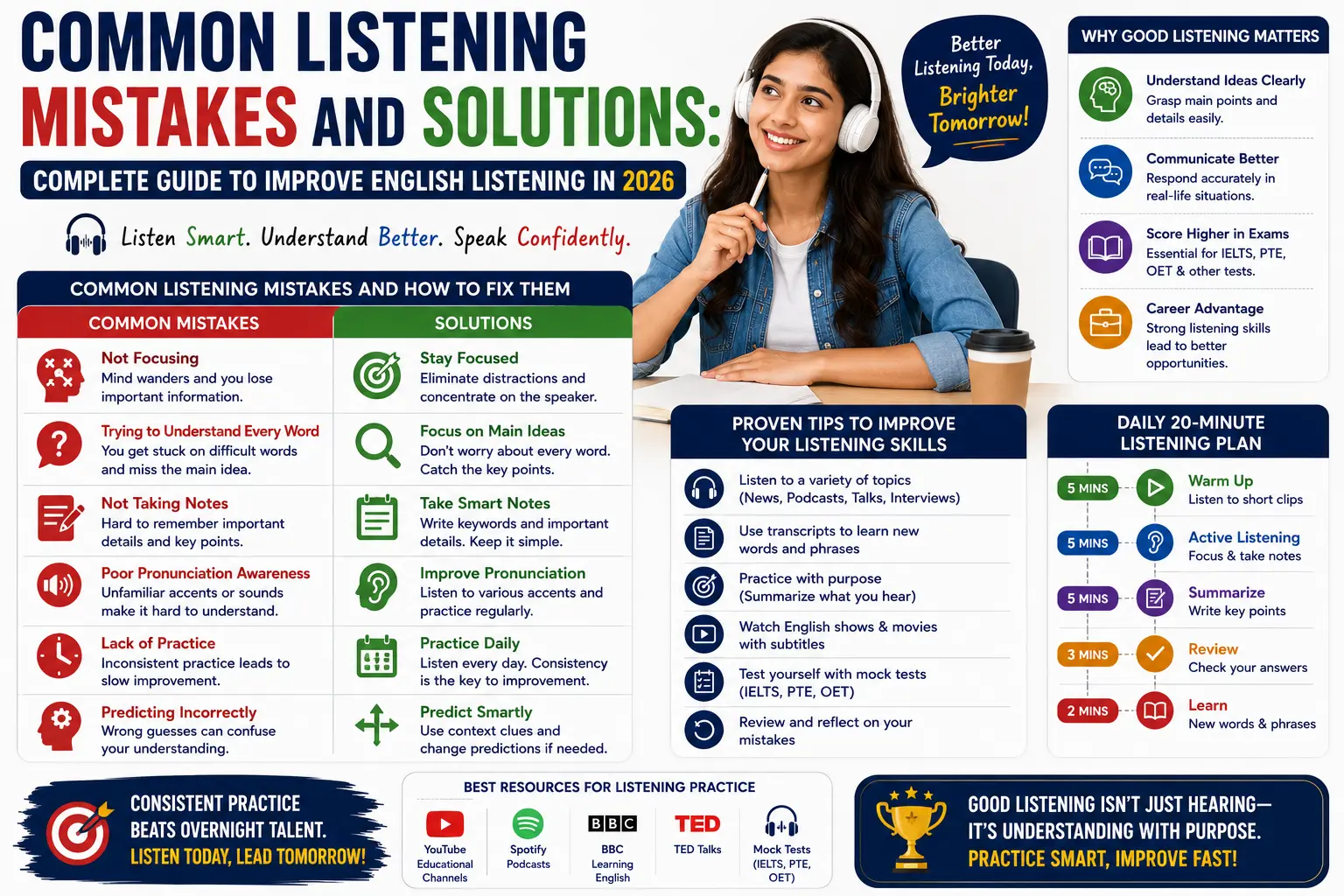

Common Listening Mistakes and Solutions: Complete Guide to Improve English Listening in 2026
Introduction
Listening is one of the most important English language skills for academic success, professional communication, international examinations, and everyday conversations. Whether you are preparing for IELTS, PTE, TOEFL, Duolingo English Test, university studies, or workplace communication, strong listening skills are essential.
Unfortunately, many English learners struggle with listening comprehension despite spending hours practicing. The reason is often not a lack of ability, but the presence of common listening mistakes that interfere with effective learning.
The good news is that these mistakes can be identified and corrected. By understanding the causes of listening difficulties and applying practical solutions, learners can improve their comprehension, confidence, and overall English proficiency much faster.
This comprehensive guide explores the most common listening mistakes English learners make in 2026, along with proven strategies and solutions to overcome them.
Listening Skills Overview
| Skill Area | Importance |
| Exams | IELTS, TOEFL, PTE, Duolingo English Test |
| Communication | Understanding conversations, lectures, and presentations |
| Career Growth | Meetings, interviews, and workplace communication |
| Academic Success | Lectures, seminars, and classroom discussions |
Why Learners Struggle with Listening
Listening challenges often result from ineffective study habits rather than language limitations.
| Common Cause | Effect on Learning |
| Poor Listening Habits | Slower comprehension development |
| Limited Vocabulary | Difficulty recognizing words |
| Lack of Practice | Reduced listening confidence |
| Fear of Mistakes | Increased anxiety and poor performance |
1. Trying to Understand Every Word
Mistake
Many learners attempt to understand and translate every single word while listening.
Why It Is a Problem
- Slows down comprehension
- Causes panic when unknown words appear
- Leads to missing subsequent information
Solution
- Focus on keywords and context
- Identify the main idea
- Practice understanding meaning without translation
| Best Strategy | Listen for overall meaning rather than every individual word. |
2. Relying Too Much on Subtitles
Mistake
Watching videos exclusively with subtitles enabled.
Why It Is a Problem
- Creates reading dependency
- Weakens listening development
- Reduces natural language processing skills
Solution
- Watch with subtitles initially
- Gradually reduce subtitle usage
- Rewatch content without subtitles
| Recommended Approach | Subtitles → Partial Subtitles → No Subtitles |
3. Not Practicing Daily
Mistake
Listening practice is often irregular and inconsistent.
Why It Is a Problem
- Slow skill development
- Reduced retention
- Inconsistent improvement
Solution
- Practice listening every day
- Dedicate 20–60 minutes daily
- Use a variety of listening resources
| Daily Goal | Consistency is more important than long study sessions. |
7. Not Building Vocabulary
Vocabulary plays a major role in listening comprehension. Many learners struggle to understand spoken English because they frequently encounter unfamiliar words, phrases, or expressions.
| Mistake | Weak vocabulary limits listening comprehension and slows down understanding. |
| Why It's a Problem | Learners cannot recognize common words quickly and often miss important information during conversations or exams. |
| Solution | Learn 5–10 new words daily, review them regularly, and practice using them in speaking and writing. |
- Create personal vocabulary notebooks.
- Learn words in context rather than isolation.
- Practice collocations and common phrases.
- Use flashcard applications for revision.
- Review vocabulary weekly.
A strong vocabulary significantly improves listening speed and accuracy.
8. Not Practicing Exam-Style Tests
Many students spend hours listening to videos, movies, and podcasts but rarely practice actual exam-style listening tests.
| Mistake | Avoiding structured listening practice designed for examinations. |
| Why It's a Problem | Students may understand general English but struggle with exam formats, question types, and time pressure. |
| Solution | Practice official IELTS and other exam listening tests regularly under timed conditions. |
Recommended Practice Routine
- Complete one full listening test every week.
- Review all incorrect answers.
- Identify recurring mistakes.
- Practice question prediction techniques.
- Monitor progress through score tracking.
Regular exam-style practice improves confidence and exam readiness.
9. Poor Concentration During Listening
Listening requires sustained attention. Even brief distractions can cause learners to miss important information.
| Mistake | Allowing distractions to interrupt listening practice. |
| Why It's a Problem | Missing key details leads to misunderstandings and incorrect answers. |
| Solution | Create a focused learning environment and gradually increase concentration levels. |
Concentration Improvement Tips
- Study in a quiet environment.
- Turn off unnecessary notifications.
- Use headphones when possible.
- Practice short listening exercises before longer ones.
- Take breaks to prevent mental fatigue.
Improved concentration enhances listening accuracy and retention.
10. Not Reviewing Mistakes
One of the most overlooked aspects of listening improvement is error analysis. Many learners complete practice tests but never investigate why mistakes occurred.
| Mistake | Ignoring mistakes after completing listening exercises. |
| Why It's a Problem | The same mistakes continue repeating because their causes remain unidentified. |
| Solution | Analyze every incorrect answer and understand the reason behind the error. |
Error Analysis Checklist
- Did I misunderstand vocabulary?
- Did I lose concentration?
- Did I miss a keyword?
- Was the accent unfamiliar?
- Did I panic after missing information?
Reviewing mistakes transforms weaknesses into learning opportunities.
Daily Listening Improvement Strategy
| Level | Daily Practice Time | Recommended Activities |
| Beginner | 20–30 Minutes | Short videos, slow podcasts, vocabulary practice |
| Intermediate | 30–45 Minutes | Podcasts, interviews, note-taking exercises |
| Advanced | 60 Minutes+ | IELTS listening tests, lectures, academic discussions |
Key Techniques to Avoid Listening Mistakes
Avoiding common listening mistakes requires more than simply listening to English content. Learners must actively develop effective listening habits and strategies that improve comprehension, focus, and retention.
| Technique | Purpose | Benefit |
| Active Listening | Focus completely on understanding meaning | Improves comprehension |
| Shadowing Method | Repeat after the speaker | Improves listening and pronunciation |
| Keyword Focus | Identify important information | Reduces overload |
| Repetition Practice | Listen multiple times | Improves clarity and understanding |
1. Active Listening
Active listening involves concentrating fully on the speaker, understanding the message, and engaging mentally with the content.
How to Practice Active Listening
- Focus completely on the audio.
- Avoid multitasking.
- Take brief notes.
- Identify key ideas and supporting details.
- Summarize what you heard.
Active listening develops deeper understanding and significantly improves retention.
2. Shadowing Method
The shadowing technique requires learners to repeat what they hear immediately after the speaker.
| Step | Listen carefully to a sentence. |
| Step | Pause and repeat exactly. |
| Step | Match pronunciation and rhythm. |
| Step | Repeat consistently. |
Shadowing strengthens listening, speaking, pronunciation, and fluency simultaneously.
3. Keyword Focus Strategy
Instead of trying to understand every word, learners should identify keywords that carry the main meaning.
Common Keywords
- Names
- Dates
- Numbers
- Locations
- Important nouns
- Action verbs
This strategy reduces stress and improves comprehension speed.
4. Repetition Practice
Repeated listening helps learners identify details they may have missed during the first attempt.
Recommended Process
- Listen once for overall meaning.
- Listen again for details.
- Review vocabulary.
- Listen a final time for complete understanding.
Repetition accelerates listening development and confidence.
Benefits of Avoiding Listening Mistakes
| Area | Benefits |
| Academic | Higher IELTS listening scores, better exam performance, stronger comprehension skills |
| Personal | Improved confidence, smoother conversations, better understanding of English media |
| Professional | Enhanced workplace communication, stronger interview performance, better collaboration skills |
Frequently Asked Questions
| Question | Answer |
| Why do I keep making listening mistakes? | Most mistakes result from inconsistent practice, poor concentration, and ineffective listening strategies. |
| How can I improve quickly? | Practice daily, build vocabulary, expose yourself to different accents, and review mistakes consistently. |
| Are subtitles harmful? | No. Subtitles are useful initially, but learners should gradually reduce dependence on them. |
| What is the most important listening strategy? | Focus on keywords and overall meaning rather than every individual word. |
Final Thoughts
Most English listening difficulties are caused by common and avoidable mistakes rather than a lack of ability. Problems such as trying to understand every word, relying too heavily on subtitles, ignoring different accents, practicing inconsistently, and failing to review mistakes can significantly slow progress.
Fortunately, these challenges can be overcome through structured practice, active listening techniques, vocabulary development, exposure to diverse accents, and regular self-evaluation. Small improvements in daily listening habits often lead to major gains in comprehension, confidence, and exam performance.
In 2026, learners have access to more resources than ever before, including podcasts, educational videos, AI-powered learning platforms, interactive listening tools, and exam preparation materials. However, the foundation of success remains consistent practice and the ability to learn from mistakes.
Whether your goal is to achieve a higher IELTS score, improve academic performance, communicate confidently in English, or succeed professionally, strong listening skills will play a crucial role in your journey.
Identify your listening weaknesses, apply the solutions outlined in this guide, practice regularly, and stay patient with your progress. Every listening session is an opportunity to improve, and consistent effort will produce lasting results.
Remember: Great listeners are not born—they are developed through focused practice, smart strategies, and continuous learning.